The Lemkin Laboratory – the Pilecki Institute and the Mieroszewski Centre sign cooperation agreement - Instytut Pileckiego

19.12.2025 (Fri)
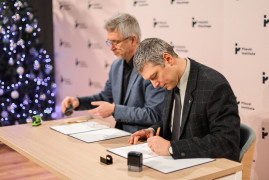
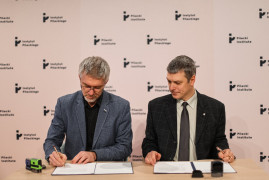
The Lemkin Laboratory – the Pilecki Institute and the Mieroszewski Centre sign cooperation agreement

“The Lemkin Laboratory” project is a joint initiative of the two institutions, which defines the terms and scope of their involvement with regard to the mutual sharing of collections of testimonies concerning war crimes, crimes against humanity and genocide committed by the Russian state in the past and present, as well as the organization and delivery of other project-related events.
The signing of the cooperation agreement between the two institutions will not only allow for the continuation of the archival work connected with the Lemkin Center currently being carried out, but will also make it possible to expand the range of scholarly activities.
“The Lemkin Laboratory” project aligns with the statutory missions of both institutions. The Pilecki Institute (on the basis of the Act of 9 November 2017 on the Witold Pilecki Institute of Solidarity and Valor) is tasked with initiating, undertaking and providing support for activities aimed at, among others: conducting research in the field of historical sciences and interdisciplinary studies using tools drawn from the humanities and the social sciences – particularly research dedicated to the study, documentation and broadening of knowledge concerning totalitarian systems and Nazi and Communist crimes committed in the 20th century.
The objective of the Mieroszewski Centre (pursuant to the Act of 25 March 2011 on the Juliusz Mieroszewski Centre for Dialogue) is to initiate and support activities aimed at fostering dialogue and understanding between Poles and the people of Eastern Europe. The Centre’s responsibilities include conducting academic research and publishing activities, disseminating knowledge about the political situation, history and culture of the region, engaging in educational activities, countering disinformation, as well as organizing expert meetings and scholarship programs.
On the basis of the agreement, both institutions will undertake joint initiatives – within the scope of their statutory powers – concerning cooperation in the field of research on issues relating to violations of international law in Central and Eastern Europe and their consequences, with a particular focus on war crimes, crimes against humanity and genocide committed by the Russian state in the past and present. They will also work together towards disseminating knowledge about the aforementioned issues both in Poland and abroad.
“The Lemkin Laboratory” project will be implemented starting on 1 January 2026.
The Lemkin Center
The Pilecki Institute launched a project under the name of the Raphael Lemkin Center for Documenting Russian Crimes in Ukraine (Lemkin Center) on 26 February 2022, in response to the Russian Federation’s aggression against Ukraine, as a result of which the Ukrainian civilian populace fell victim to numerous war crimes. The Center was named after Raphael Lemkin, a Polish lawyer of Jewish origin and author of the term “genocide” who co-created the UN Convention on the Prevention and Punishment of the Crime of Genocide (1948). The project has been carried out since the outbreak of the full-scale war in February 2022 and focused on collecting various accounts from civilians in order to preserve evidence of crimes committed by Russian troops – for use, among others, by scholars and journalists. The project focused in particular on: gathering accounts of eyewitnesses documenting military operations of Russian troops in the territory of Ukraine, with special emphasis on individual crimes committed by soldiers of the Russian Federation, as well as collecting information and footage concerning the deliberate destruction by Russian forces of Ukrainian civilian infrastructure and monuments, including those designated by UNESCO as World Heritage Sites. The testimonies form the basis for an anonymized archive (available in the Pilecki Institute Archives), which contains accounts on crimes committed by Russian troops in the territory of Ukraine.
The accounts were collected in various formats: preliminary questionnaires filled in by the witnesses in their native tongue (available language versions: Ukrainian, Russian, Polish and English), audio accounts, and video interviews with witnesses to Russian aggression.
As part of the Lemkin Center project, about 1,600 accounts in text and audiovisual formats have been collected thus far. Presently, the questionnaires, video interviews, photographs and footage documenting Russian crimes against Ukrainian civilians are being anonymized, digitalized, as well as transcribed from Ukrainian and Russian into Polish and English.
Three reports were compiled and published on the basis of the collected accounts: “‘Like it or not, it’s your duty, my beauty’. Unpunished Crimes: Sexual Violence of the Russian Occupying Forces Against Ukrainian Women”, “A Stolen Childhood. Crimes against children committed by Russian troops”, “‘We do not attack civilians...’The Green Corridor in Lypivka as a trap set by the Russian occupying forces” – the reports can be downloaded from: https://instytutpileckiego.pl/pl/badania/centrum-lemkina/raporty
The reports are available in four language versions: Polish, English, Ukrainian and German, and have been presented both in Poland and abroad.
The collected accounts are not classified, and can thus serve as a material for scholarly analysis or a source of information for journalists, which can be quoted by the media all over the world. As part of the project, the Lemkin Center fosters cooperation with scholars, researchers, historians, lawyers, publicists and archivists, as well as with public institutions, academic centers, Ukrainian archives and NGOs.
More information about the Lemkin Center project can be found at: https://instytutpileckiego.pl/pl/badania/centrum-lemkina
See also
- Previously unpublished German archival materials from France’s ECPAD at the Pilecki Institute and the Warsaw Rising Museum
News
Previously unpublished German archival materials from France’s ECPAD at the Pilecki Institute and the Warsaw Rising Museum
The Witold Pilecki Institute of Solidarity and Valor and the Warsaw Rising Museum have signed a strategic trilateral cooperation agreement with ECPAD (Établissement de Communication et de Production Audiovisuelle de la Défense / Defense Communication and Audiovisual Production Center), the French military audiovisual archive based in Ivry-sur-Seine, France. The agreement gives the Polish institutions access to unique Second World War photographs previously unseen in Poland, opens access to the vast holdings of the French archive, and launches a partnership of major significance for research into Polish history.
- „Soviet Central Asia as a Totalitarian Testing Ground” - international academic conference
News
„Soviet Central Asia as a Totalitarian Testing Ground” - international academic conference
Three days, dozens of presentations, and researchers from Poland and abroad summed up the international academic conference held at the Pilecki Institute in Warsaw on 2–4 September.
- The hitherto unknown memoirs of a German official from occupied Poland have been donated to the Pilecki Institute
News
The hitherto unknown memoirs of a German official from occupied Poland have been donated to the Pilecki Institute
A unique document has been added to the Pilecki Institute’s archives: the previously unpublished and unknown memoirs of a German official who worked in the civil administration of the General Government during the Second World War.
- Evil Woven into Everyday Life | Dr Joanna Nikel on the Memoirs of a German Official from His Stay in the General Government
News
Evil Woven into Everyday Life | Dr Joanna Nikel on the Memoirs of a German Official from His Stay in the General Government
"It is rare for a document to find its way into archival collections in which the voice of an official of the occupation apparatus himself – written down without any intention of accusation, and even stressing his own sense of normality – becomes one of the most eloquent testimonies to the criminal nature of the system he served", writes Dr Joanna Nikel in her initial commentary on the materials received by the Pilecki Institute.
- 14 books nominated for this year’s Witold Pilecki International Book Award
News
14 books nominated for this year’s Witold Pilecki International Book Award
On Saturday, 5 September, at the Autumn Book Fair in Warsaw, the Pilecki Institute announced the titles and authors of 14 books nominated for this year’s Witold Pilecki International Book Award.
- New Jork | Exhibition: Between Life and Death. Stories of Rescue during the Holocaust
News
New Jork | Exhibition: Between Life and Death. Stories of Rescue during the Holocaust
Through October 29, the Pilecki Institute in New York is hosting an exhibition about the people who risked their own lives to save Jews during the Holocaust—and those who survived thanks to their courage.
- „Soviet Central Asia as a Totalitarian Testing Ground” - international academic conference
News
„Soviet Central Asia as a Totalitarian Testing Ground” - international academic conference
The international academic conference organized by the Pilecki Institute is the first initiative in Poland to bring together interdisciplinary research on Soviet Central Asia, a region with an exceptionally complex history of totalitarianism, mass repression, and forced deportations, that also include the experiences of Poles.
- Karol Madaj appointed Director of the Witold Pilecki Institute of Solidarity and Valor
News
Karol Madaj appointed Director of the Witold Pilecki Institute of Solidarity and Valor
Marta Cienkowska, the Minister of Culture and National Heritage, has appointed Karol Madaj Director of the Witold Pilecki Institute of Solidarity and Valor in Warsaw. His five-year term will begin on 30 August 2026. From 1 September 2025, Karol Madaj served as the acting director of the Pilecki Institute.
- Hacker attack on the websites of the Pilecki Institute in Warsaw, Berlin, and Augustów
News
Hacker attack on the websites of the Pilecki Institute in Warsaw, Berlin, and Augustów
On the night of August 13–14 our websites suffered another serious hacking attack. Content bearing the hallmarks of Russian propaganda and disinformation — targeting Polish history and reinforcing anti-Ukrainian narratives — was deliberately placed on the Institute's pages devoted to Augustów, Berlin, and Warsaw.
- Academic conference “Oppositional Engagement of Women in Authoritarian and Totalitarian Systems of the 20th Century: Poland in a Comparative European Perspective (1919–1989)”
News
Academic conference “Oppositional Engagement of Women in Authoritarian and Totalitarian Systems of the 20th Century: Poland in a Comparative European Perspective (1919–1989)”
The second academic conference in a series “Oppositional Engagement of Women in Authoritarian and Totalitarian Systems of the 20th Century: Poland in a Comparative European Perspective (1919–1989)” brought together representatives of various fields of the humanities and social sciences from numerous research centers in Poland and abroad.
- Accountability for War Crimes. New book from Pilecki's expert
News
Accountability for War Crimes. New book from Pilecki's expert
It is an expanded English-language edition of the monograph "Problem odpowiedzialności karnej za zbrodnie wojenne w pracach rządu polskiego na emigracji (1939–1945)", which in 2023 was awarded a grant under the Ministry of Science and Higher Education’s “Excellent Science II” program for the translation and open-access publication of the book abroad.
- 12 July | Day of Remembrance for the Victims of the Augustów Roundup
News
12 July | Day of Remembrance for the Victims of the Augustów Roundup
12 July is celebrated as the National Day of Remembrance for the Victims of the Augustów Roundup. The roundup began 81 years ago on this day – on 12 July 1945, two months after the end of the Second World War.