Conference summary “Die Haltung der deutschen Minderheiten im besetzten Europa (1939–1945). Forschungsmethoden, soziale Kontexte und Nachkriegsfolgen” - Instytut Pileckiego

02.12.2025 (Tue)
Conference summary “Die Haltung der deutschen Minderheiten im besetzten Europa (1939–1945). Forschungsmethoden, soziale Kontexte und Nachkriegsfolgen”
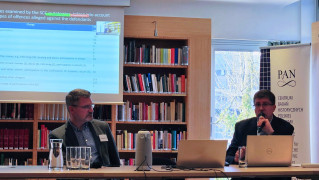
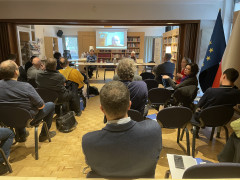
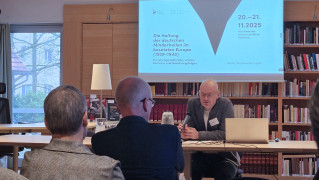
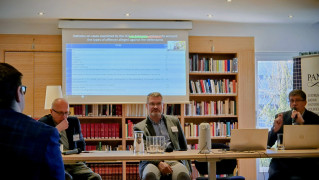
On 20–21 November 2025, an international academic conference was held in Berlin and addressed issues of the attitudes of the German population during the occupation and their postwar fate.

Conference: “Postawy mniejszości niemieckich w okupowanej Europie (1939–1945). Metody badań, społeczne konteksty i powojenne konsekwencje” [“The attitudes of German minorities in occupied Europe (1939–1945). Research methods, social contexts, and postwar consequences”]
The conference was organized by the Pilecki Institute, the Pilecki Institute in Berlin, and the Center for Historical Research of the Polish Academy of Sciences in Berlin. The event was hosted at the Center’s headquarters at Majakowskiring 47 in Berlin.
The first day featured presentations on the attitudes of German minorities in various regions of occupied Europe, with particular emphasis on Central and Eastern Europe. In the broad approach to research adopted by the organizers, this concept also encompassed parts of Southeast Europe, including Romania and Bulgaria, which was reflected in presentations devoted to German minorities in these countries.
Speakers included Gerhard Wolf, Ottmar Trască, Thomas Bohn, Tomasz Chinciński, Piotr Madajczyk, Joanna Nikel, Marcin Przegiętka, Monika Napora, Ryszard Kaczmarek, Grzegorz Bębnik, and Michał Turski, with commentary and discussion led by Andrej Angrick, Isabel Röskau-Rydel, Gerhard Wolf, and Piotr Madajczyk.
The second day of the conference centered on a panel discussion on new publications on the history and memory of German minorities in Central and Eastern Europe. There were debates on books by Ryszard Kaczmarek (Czy jestem Niemcem? Przesiedleńcy z Polski do RFN i NRD w latach 1950–1991), Isabel Röskau-Rydel (Deutsche im Distrikt Krakau 1939–1945. Minderheit, Volksgemeinschaft, Besatzer) and Adam Dziurok (Osądzenie przestępstw okresu II wojny światowej przez specjalny sąd karny w Katowicach w latach 1945–1946).
One of the goals of the conference was to present the latest research findings on the attitudes and agency of German minorities under occupation, considering the diversity of attitudes, social contexts, and postwar mechanisms of accountability. Participants also reflected on breaking the stereotypical image of a uniform “Volksgemeinschaft” and on the importance of microhistorical research in this area. This goal was achieved by presenting partial results of research carried out as part of the project “Polish Germans 1939–1945. The Attitudes and Situation of Polish Citizens of German Ethnic Nationality in Lands Incorporated Into the Third Reich and in the General Government” (NPRH/DN/SN/0105/2023/12) and an in-depth discussion of these results during individual panels and thematic sections.
See also
- Previously unpublished German archival materials from France’s ECPAD at the Pilecki Institute and the Warsaw Rising Museum
News
Previously unpublished German archival materials from France’s ECPAD at the Pilecki Institute and the Warsaw Rising Museum
The Witold Pilecki Institute of Solidarity and Valor and the Warsaw Rising Museum have signed a strategic trilateral cooperation agreement with ECPAD (Établissement de Communication et de Production Audiovisuelle de la Défense / Defense Communication and Audiovisual Production Center), the French military audiovisual archive based in Ivry-sur-Seine, France. The agreement gives the Polish institutions access to unique Second World War photographs previously unseen in Poland, opens access to the vast holdings of the French archive, and launches a partnership of major significance for research into Polish history.
- „Soviet Central Asia as a Totalitarian Testing Ground” - international academic conference
News
„Soviet Central Asia as a Totalitarian Testing Ground” - international academic conference
Three days, dozens of presentations, and researchers from Poland and abroad summed up the international academic conference held at the Pilecki Institute in Warsaw on 2–4 September.
- The hitherto unknown memoirs of a German official from occupied Poland have been donated to the Pilecki Institute
News
The hitherto unknown memoirs of a German official from occupied Poland have been donated to the Pilecki Institute
A unique document has been added to the Pilecki Institute’s archives: the previously unpublished and unknown memoirs of a German official who worked in the civil administration of the General Government during the Second World War.
- Evil Woven into Everyday Life | Dr Joanna Nikel on the Memoirs of a German Official from His Stay in the General Government
News
Evil Woven into Everyday Life | Dr Joanna Nikel on the Memoirs of a German Official from His Stay in the General Government
"It is rare for a document to find its way into archival collections in which the voice of an official of the occupation apparatus himself – written down without any intention of accusation, and even stressing his own sense of normality – becomes one of the most eloquent testimonies to the criminal nature of the system he served", writes Dr Joanna Nikel in her initial commentary on the materials received by the Pilecki Institute.
- 14 books nominated for this year’s Witold Pilecki International Book Award
News
14 books nominated for this year’s Witold Pilecki International Book Award
On Saturday, 5 September, at the Autumn Book Fair in Warsaw, the Pilecki Institute announced the titles and authors of 14 books nominated for this year’s Witold Pilecki International Book Award.
- New Jork | Exhibition: Between Life and Death. Stories of Rescue during the Holocaust
News
New Jork | Exhibition: Between Life and Death. Stories of Rescue during the Holocaust
Through October 29, the Pilecki Institute in New York is hosting an exhibition about the people who risked their own lives to save Jews during the Holocaust—and those who survived thanks to their courage.
- „Soviet Central Asia as a Totalitarian Testing Ground” - international academic conference
News
„Soviet Central Asia as a Totalitarian Testing Ground” - international academic conference
The international academic conference organized by the Pilecki Institute is the first initiative in Poland to bring together interdisciplinary research on Soviet Central Asia, a region with an exceptionally complex history of totalitarianism, mass repression, and forced deportations, that also include the experiences of Poles.
- Karol Madaj appointed Director of the Witold Pilecki Institute of Solidarity and Valor
News
Karol Madaj appointed Director of the Witold Pilecki Institute of Solidarity and Valor
Marta Cienkowska, the Minister of Culture and National Heritage, has appointed Karol Madaj Director of the Witold Pilecki Institute of Solidarity and Valor in Warsaw. His five-year term will begin on 30 August 2026. From 1 September 2025, Karol Madaj served as the acting director of the Pilecki Institute.
- Hacker attack on the websites of the Pilecki Institute in Warsaw, Berlin, and Augustów
News
Hacker attack on the websites of the Pilecki Institute in Warsaw, Berlin, and Augustów
On the night of August 13–14 our websites suffered another serious hacking attack. Content bearing the hallmarks of Russian propaganda and disinformation — targeting Polish history and reinforcing anti-Ukrainian narratives — was deliberately placed on the Institute's pages devoted to Augustów, Berlin, and Warsaw.
- Academic conference “Oppositional Engagement of Women in Authoritarian and Totalitarian Systems of the 20th Century: Poland in a Comparative European Perspective (1919–1989)”
News
Academic conference “Oppositional Engagement of Women in Authoritarian and Totalitarian Systems of the 20th Century: Poland in a Comparative European Perspective (1919–1989)”
The second academic conference in a series “Oppositional Engagement of Women in Authoritarian and Totalitarian Systems of the 20th Century: Poland in a Comparative European Perspective (1919–1989)” brought together representatives of various fields of the humanities and social sciences from numerous research centers in Poland and abroad.
- Accountability for War Crimes. New book from Pilecki's expert
News
Accountability for War Crimes. New book from Pilecki's expert
It is an expanded English-language edition of the monograph "Problem odpowiedzialności karnej za zbrodnie wojenne w pracach rządu polskiego na emigracji (1939–1945)", which in 2023 was awarded a grant under the Ministry of Science and Higher Education’s “Excellent Science II” program for the translation and open-access publication of the book abroad.
- 12 July | Day of Remembrance for the Victims of the Augustów Roundup
News
12 July | Day of Remembrance for the Victims of the Augustów Roundup
12 July is celebrated as the National Day of Remembrance for the Victims of the Augustów Roundup. The roundup began 81 years ago on this day – on 12 July 1945, two months after the end of the Second World War.