PORTRAITS | Adam Bałdych Quintet - Instytut Pileckiego

16.01.2026 (Fri)
PORTRAITS | Adam Bałdych Quintet
“Portraits” is a moving story told through sound, in which jazz meets history and individual fates intertwine with the collective experience.
The project was created by Adam Bałdych, an outstanding composer and violin virtuoso, in collaboration with the Pilecki Institute. It is an attempt to use music to close the distance to the difficult experiences of witnesses and victims of the Second World War, and at the same time to pay tribute to them. The album was created as part of the celebrations of the 85th anniversary of the outbreak of the Second World War.
The Latin word protrahere means “to bring to light,” and this is exactly what Adam Bałdych has done with the emotions hidden in the accounts of witnesses of the Second World War. The artist drew on archival materials from the Pilecki Institute and created music that conveys what is difficult to express in words.

“Portraits” consists of 17 compositions that bring out and convey emotions hidden in archival testimonies in an extraordinary way. The album combines elements of jazz, classical music, and traditional Polish music.
“As an institute that researches and collects archives on German and Soviet totalitarianism, we were looking for a way to ensure that these stories would not only appeal to scholars and scientists, but would also reach a wide and diverse audience. It is a matter of the phenomenon of experience. Stories become close to us with the aid of the emotions they evoke. And it was precisely this emotional component that became the source of the decision to undertake the project with Adam Bałdych, who has been involved in musical improvisation for years. We wanted him to bring out the content hidden in these stories, ask questions of himself, and confront these stories,” said Jakub Kiersikowski, the originator of the project from the Pilecki Institute.
Portraits of emotions
“Work on the compositions was very intense. As an artist, I could not remain indifferent to these stories. Although I knew them from school and from my grandparents’ retellings, I belong to a generation that is distanced from this kind of content, but here they evoked a whole range of emotions in me. The music poured out on its own,” Adam Bałdych said.

Calling for peace
In interviews promoting the album, the artist emphasized that he did not want to calm listeners with this album, but rather to stimulate their emotions and evoke a certain unease in them. The album is a kind of anti-war manifesto, a clear and noticeable appeal for an end to conflicts such as the one taking place just beyond our eastern border. The compositions evoke a variety of wartime experiences that are well known to victims of military interventions both in the 20th century and in the modern day: dilemmas in the face of difficult choices, the pursuit of happiness, suffering and loss, and the longing for freedom.

“I received materials that are notes, content that I began to assimilate. I read the stories of people who were put in situations where I don’t know how I would have behaved in their shoes. And this encounter with the authentic history of these people evoked a lot of emotions in me and brought back the feeling that we ourselves are struggling with various threats today. (...) These stories allowed me to bring out what I am experiencing today, they asked questions – what does this anxiety mean for me? What are these times that are changing so quickly?” the violinist explained.
The Institute provided the musician with film recordings of witnesses to history, scans of testimonies from the Chronicles of Terror online database, as well as research materials on the activities of the Ładoś Group (a joint operation by Polish diplomats residing in Bern and Jewish communities, whose aim was to save Jews from the Holocaust, which became the topic of an exhibition by the Pilecki Institute – more). The topics of the accounts referred to pacification in Michniów, the hiding of Jews by Poles, the Wola Massacre, and the role of the camp orchestra in KL Auschwitz, among others. Selected accounts from “Witnesses to the Age” concerned the deportation of Poles to Siberia, the Auschwitz-Birkenau camp, the German camp for children in Łódź, and the pacification of Dąbrowa Dolna. Adam Bałdych supplemented his research with the memoirs of composer Szymon Laks, published in 1967, entitled “Gry Oświęcimskie” (“The Auschwitz Games”).

“Portraits” by the Adam Bałdych Quintet – a new way of telling stories about the past
The album presents 17 musical compositions. The pieces evoke a variety of wartime experiences that are well known to victims of military interventions both in the 20th century and in the modern day: dilemmas in the face of difficult choices, the pursuit of happiness, suffering and loss, and the longing for freedom. Adam Bałdych’s compositions depict man as he is: equally prone to chaos and destruction as he is to creating beautiful, sublime things.


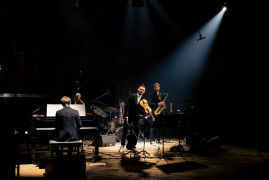
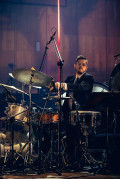
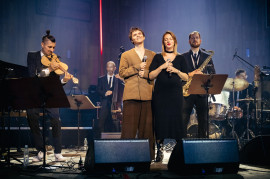
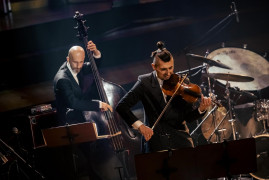
The first public performance of the composition took place on 21 September 2025, on International Peace Day, at the Witold Lutosławski Concert Studio of Polish Radio in Warsaw (more about the event). A few days later (25 September), Adam Bałdych and his band played at St. Elisabeth-Kirche in Berlin (more about the event). Another opportunity to hear a live performance of songs from the album “Portraits” was the grand opening of the new headquarters of the Pilecki Institute on Sienna Street in Warsaw in September 2025.

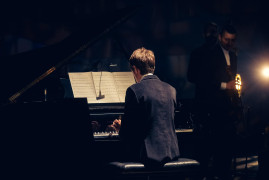
The CD and vinyl versions of the album can be purchased at the Pilecki Institute bookstore (click).
Music videos
The album “Portraits” is accompanied by six music videos.
„Protest song”
„Canon”
„Niebo złote ci otworzę”
„Tree of knowledge”
„Genesis”
„Lullaby for Ulma Family”
Adam Bałdych – violinist and composer, known as the “violin prodigy”, began his career at the age of 14. He developed his own style, which became an inspiration for a new generation of improvisational violinists. Adam Bałdych is valued for his creativity in the field of jazz and contemporary music, his creative combination of both genres, and the expressiveness of his musical interpretations. He has participated in the recording of nearly 20 albums. The latest album by Adam Bałdych and Leszek Możdżer, “Passacaglia”, was released in January 2024 (biography: www.adambaldych.com).
Download
See also
- Previously unpublished German archival materials from France’s ECPAD at the Pilecki Institute and the Warsaw Rising Museum
News
Previously unpublished German archival materials from France’s ECPAD at the Pilecki Institute and the Warsaw Rising Museum
The Witold Pilecki Institute of Solidarity and Valor and the Warsaw Rising Museum have signed a strategic trilateral cooperation agreement with ECPAD (Établissement de Communication et de Production Audiovisuelle de la Défense / Defense Communication and Audiovisual Production Center), the French military audiovisual archive based in Ivry-sur-Seine, France. The agreement gives the Polish institutions access to unique Second World War photographs previously unseen in Poland, opens access to the vast holdings of the French archive, and launches a partnership of major significance for research into Polish history.
- „Soviet Central Asia as a Totalitarian Testing Ground” - international academic conference
News
„Soviet Central Asia as a Totalitarian Testing Ground” - international academic conference
Three days, dozens of presentations, and researchers from Poland and abroad summed up the international academic conference held at the Pilecki Institute in Warsaw on 2–4 September.
- The hitherto unknown memoirs of a German official from occupied Poland have been donated to the Pilecki Institute
News
The hitherto unknown memoirs of a German official from occupied Poland have been donated to the Pilecki Institute
A unique document has been added to the Pilecki Institute’s archives: the previously unpublished and unknown memoirs of a German official who worked in the civil administration of the General Government during the Second World War.
- Evil Woven into Everyday Life | Dr Joanna Nikel on the Memoirs of a German Official from His Stay in the General Government
News
Evil Woven into Everyday Life | Dr Joanna Nikel on the Memoirs of a German Official from His Stay in the General Government
"It is rare for a document to find its way into archival collections in which the voice of an official of the occupation apparatus himself – written down without any intention of accusation, and even stressing his own sense of normality – becomes one of the most eloquent testimonies to the criminal nature of the system he served", writes Dr Joanna Nikel in her initial commentary on the materials received by the Pilecki Institute.
- 14 books nominated for this year’s Witold Pilecki International Book Award
News
14 books nominated for this year’s Witold Pilecki International Book Award
On Saturday, 5 September, at the Autumn Book Fair in Warsaw, the Pilecki Institute announced the titles and authors of 14 books nominated for this year’s Witold Pilecki International Book Award.
- New Jork | Exhibition: Between Life and Death. Stories of Rescue during the Holocaust
News
New Jork | Exhibition: Between Life and Death. Stories of Rescue during the Holocaust
Through October 29, the Pilecki Institute in New York is hosting an exhibition about the people who risked their own lives to save Jews during the Holocaust—and those who survived thanks to their courage.
- „Soviet Central Asia as a Totalitarian Testing Ground” - international academic conference
News
„Soviet Central Asia as a Totalitarian Testing Ground” - international academic conference
The international academic conference organized by the Pilecki Institute is the first initiative in Poland to bring together interdisciplinary research on Soviet Central Asia, a region with an exceptionally complex history of totalitarianism, mass repression, and forced deportations, that also include the experiences of Poles.
- Karol Madaj appointed Director of the Witold Pilecki Institute of Solidarity and Valor
News
Karol Madaj appointed Director of the Witold Pilecki Institute of Solidarity and Valor
Marta Cienkowska, the Minister of Culture and National Heritage, has appointed Karol Madaj Director of the Witold Pilecki Institute of Solidarity and Valor in Warsaw. His five-year term will begin on 30 August 2026. From 1 September 2025, Karol Madaj served as the acting director of the Pilecki Institute.
- Hacker attack on the websites of the Pilecki Institute in Warsaw, Berlin, and Augustów
News
Hacker attack on the websites of the Pilecki Institute in Warsaw, Berlin, and Augustów
On the night of August 13–14 our websites suffered another serious hacking attack. Content bearing the hallmarks of Russian propaganda and disinformation — targeting Polish history and reinforcing anti-Ukrainian narratives — was deliberately placed on the Institute's pages devoted to Augustów, Berlin, and Warsaw.
- Academic conference “Oppositional Engagement of Women in Authoritarian and Totalitarian Systems of the 20th Century: Poland in a Comparative European Perspective (1919–1989)”
News
Academic conference “Oppositional Engagement of Women in Authoritarian and Totalitarian Systems of the 20th Century: Poland in a Comparative European Perspective (1919–1989)”
The second academic conference in a series “Oppositional Engagement of Women in Authoritarian and Totalitarian Systems of the 20th Century: Poland in a Comparative European Perspective (1919–1989)” brought together representatives of various fields of the humanities and social sciences from numerous research centers in Poland and abroad.
- Accountability for War Crimes. New book from Pilecki's expert
News
Accountability for War Crimes. New book from Pilecki's expert
It is an expanded English-language edition of the monograph "Problem odpowiedzialności karnej za zbrodnie wojenne w pracach rządu polskiego na emigracji (1939–1945)", which in 2023 was awarded a grant under the Ministry of Science and Higher Education’s “Excellent Science II” program for the translation and open-access publication of the book abroad.
- 12 July | Day of Remembrance for the Victims of the Augustów Roundup
News
12 July | Day of Remembrance for the Victims of the Augustów Roundup
12 July is celebrated as the National Day of Remembrance for the Victims of the Augustów Roundup. The roundup began 81 years ago on this day – on 12 July 1945, two months after the end of the Second World War.