Fumi Matsuzawa - Instytut Pileckiego
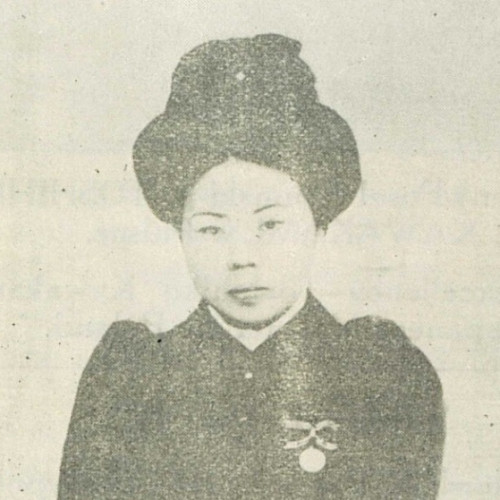
A nurse who became a symbol of the dedication shown by the Japanese in caring for Polish children.
She was born in a small village in Niigata Prefecture, located in the central part of the island of Honshu. She received her education at local schools.
In 1918, she enrolled in the nursing school affiliated with the Japanese Red Cross Hospital in Tokyo. After graduating in 1921, she was assigned to care for a group of Polish children who had arrived in Japan from Russia, which was engulfed by revolution and civil war. The assistance provided to 765 orphans would not have been possible without the involvement of the Japanese authorities, the Polish Relief Committee for Children of the Far East, and the Japanese Red Cross Society, including many doctors and
nurses. The young Poles, who had experienced hunger and often extreme poverty in Russia, were able for the first time in Japan to feel completely safe, without fear of what the future might bring.
However, despite a strict sanitary and hygiene regime, some of the children contracted typhus in March 1921. They were admitted to the infectious diseases ward of a Tokyo hospital. Nurse Matsuzawa cared for the most seriously ill children with great dedication and devotion. Unfortunately, she also contracted typhus. She did not survive the illness and died on 11 July 1921. Thanks to her and the other members of the medical staff, all the infected children survived. In 1921, Fumi Matsuzawa was posthumously awarded the Polish Red Cross Medal, and in 1929, the Honorary Badge
of the Polish Red Cross.
Photo credit: Central Archives of Modern Records in Warsaw.
See also
- Paul Super

awarded
Paul Super
(1880–1949)Paul Super was only supposed to spend eight months in Poland. In 1922, he came to Warsaw with his family to build a local branch of the Young Men’s Christian Association (YMCA).
- Anna Jelínková (1918–2009)
awarded
Anna Jelínková (1918–2009)
During the war the Jelíneks saved more than 40 people: the Jewish families of Fischer and Fronk, the Polish family of Siekierski, Feliks Zubkiewicz, whose loved ones were killed by the Ukrainian Insurgent Army, and the Ukrainian family of Lutsyuk.
- Ferdinánd Leó Miklósi
awarded
Ferdinánd Leó Miklósi
(1889–1968)As a 21-year-old in 1910, he was a member of the Hungarian delegation that participated in the unveiling of the Grunwald Monument in Kraków.