Ann Jacques - Instytut Pileckiego
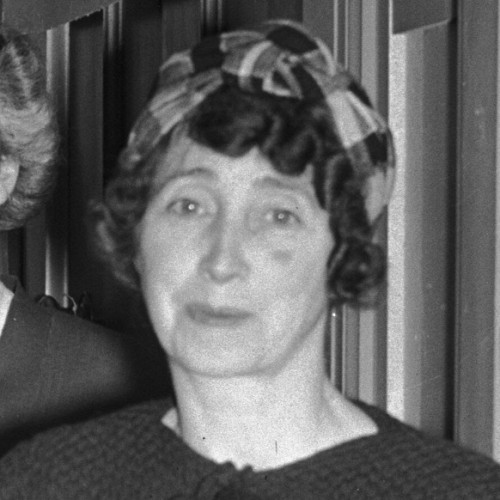
Secretary of the Polish Army League in New Zealand, an organization that supported Polish soldiers during World War II. Together with her husband William, she supported, among other initiatives, the center for Polish orphans in Pahiatua.
She was born in the suburbs of Leeds, England, and went on to graduate from the prestigious Le Cordon Bleu culinary school in Paris. Following her marriage, she settled in Palmerston North, New Zealand, where she became involved in social and charitable work.
During the Second World War, following a meeting with Maria Wodzicka, the wife of the Polish Consul in Wellington, Ann Jacques and Lorna Bale established the Polish Army League in December 1941. Jacques became the association’s secretary. The organization aimed to offer material and moral support to Polish soldiers fighting in the Middle East and in Italy. The women sent Poles care packages and corresponded with them. The first letters and parcels were dispatched in February 1942. At the peak of its operations, the Polish Army League boasted some 6,000 members who took care of almost 8,000 soldiers. The association operated until 1946.
The Polish Army League played a significant role in securing the support of New Zealand society for the Polish cause. This led, among other things, to the welcoming of Polish orphans from the USSR in October 1944 and their placement in a specially prepared camp in Pahiatua. Ann Jacques served on the committee in charge of setting up the camp, which she continued to support – together with her husband, William – throughout its operation.
After the end of the war, she maintained an active presence within the local community. In 1954, she organized Queen Elizabeth II’s visit to Palmerston North. Ann Jacques passed away on 22 August 1994.
“Constant fuel to the bright flame [of sympathy towards Poland] is added by
the Polish Army League with headquarters in Palmerston North, where the first spark was lit away back in 1941 when Countess Wodzicka addressed members of women’s organizations not long after her arrival in New Zealand. Then it was that two of her hearers, Mrs. A.K. Jacques and Mrs. L.E. Bale, formed a circle locally to write to soldiers of the Polish Army serving in Libya, realizing their isolation and loneliness and their bitter anxiety for their families and friends.”
Polish Eagle on Red Cross Wing. Friendship-Flights of Letters and Comforts, “New Zealand Free Lance” 1944, no. 48, p. 8
Photo of Anna Jacques at the top of the page: Ian Matheson City Archives, Palmerston North.
See also
- Raymond Voegeli

awarded
Raymond Voegeli
(1894–1980)Helping those in need was the meaning of Father Raymond Voegeli’s life. Before the war, he was a member of the Camillians, whose main mission was ministering to the sick.
- gen. Lóránd Utassy (1897— 1974)
awarded
gen. Lóránd Utassy (1897— 1974)
Utassy denied the Gestapo access to the internment camps and refused to surrender Polish soldiers. He also participated in talks with the Red Cross, aiming to establish it as the representation of Poles who had found themselves on Hungarian soil.
- Piotr Parfeniuk
awarded
Piotr Parfeniuk
(1904–1993)Although his given name was Petro, Parfeniuk used the name Piotr for the majority of his long life. Before the outbreak of the war, he met his future wife, Stanisława, from the Polish Czerwinek family.