Hans Dahl (1917–2007) Adolf Dahl (1913–2007) - Instytut Pileckiego
Hans Dahl (1917–2007) Adolf Dahl (1913–2007)
Awarded in 2026.
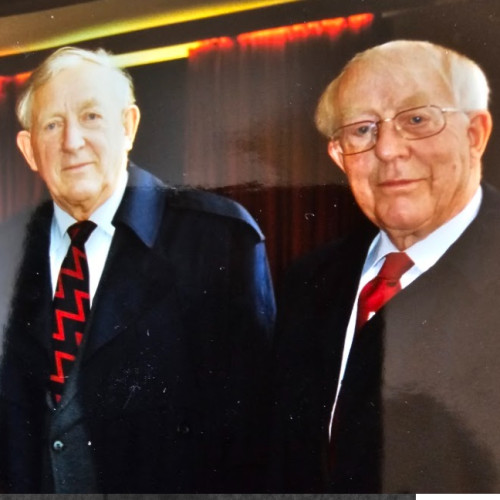
Brothers who twice helped Polish prisoners of war who had escaped from camps in their attempts to reach Sweden.
In June 1940, Norway was occupied by Germany. The government and the king went to London, where Norway’s legal government-in-exile operated until the end of the Second World War. In Norway, a puppet government was installed, with Vidkun Quisling serving as Prime Minister from 1942. A significant part of the Norwegian population expressed opposition to the occupiers by engaging in various forms of resistance. Among those unwilling to remain passive were two brothers, Adolf and Hans Dahl. They became members of XU, a clandestine intelligence network operating in Norway on behalf of the Allies.
Together with their friend Niels Jørgensen, the brothers operated in Namsos, a town in the central part of the country. They gathered information about the activities of the occupying forces in the town and surrounding area and also provided assistance to escapees from German labor camps and prisoner-of-war camps. In the summer of 1942, they twice helped Polish prisoners of war who had escaped from camps in attempts to reach Sweden. The first pair were most likely Zygmunt Kozłowski and Franciszek Konieczny, who, with their support, safely reached their destination in August 1942. The next attempt, however, ended in failure. Two Poles, probably Władysław Sitko and Albert Kowalewski, were captured by the Germans in September 1942, just a few days after their escape. The Norwegians were arrested shortly afterward. The Dahl brothers were imprisoned at the camp in Falstad, located about
80 kilometers north of Trondheim. After six months, they were released and returned to Namsos, where they continued their intelligence work. In mid-December 1943, facing the threat of exposure, they fled to Sweden. They continued working for the resistance movement.
After the war, they returned to Norway and settled in Namsos. Both started families there. Adolf ran a store and worked as a ski instructor. Hans worked for a construction company and later at the local hospital as an administrator and financial director. They both died in 2007: Adolf on 10 January and Hans on 2 July.
“There were two Poles who had escaped. [...] We worked out how to get them
farther on, and we managed to drive them up beyond the Namsen, [...] where
bicycles had already been prepared for us, along with two extra ones. We then cycled to Homstad. [...] We managed to obtain a small pocket compass that at least indicated north and south, as well as a sketch map or part of a map showing where Sweden was, which they ultimately managed to reach. We mapped out the route they should take to get there. [...] In the end, they reached Sweden.”
Interview with Hans Dahl, 6 June 1997, Falstad Center
The photo at the top of the page shows brothers Alfons and Hans Dahl. Source: Ole Petter Dahl's private archive.
See also
- Sawa Kowtoniuk (1888–ok. 1970) Ustyna Kowtoniuk (1895–ok. 1980)

awarded
Sawa Kowtoniuk (1888–ok. 1970) Ustyna Kowtoniuk (1895–ok. 1980)
The Kovtoniuks gave shelter to several families: the Sławińskis, Romanowskis, Maciaszeks, and the Okólskis.
- Alfred Iversen
awarded
Alfred Iversen
(1908–1987)A Norwegian citizen who helped Poles, prisoners of a German forced labor camp, escape to Sweden.
- Tassybaj Abdikarimow
awarded
Tassybaj Abdikarimow
(1938–2020)The Jabłoński family were in an difficult situation — terrible sanitary conditions, shortage of food, and hard labor in the sun caused a very high mortality rate among he inhabitants. During this difficult time, help came from a 16-year-old Kazakh.