Germany on Poland: Images, Memory and “Blind Spots” | Event video recording - Instytut Pileckiego

10.03.2026 (Tue)
Germany on Poland: Images, Memory and “Blind Spots” | Event video recording
“What is one ‘missing frame’ in the German imagination of Poland?” Dr. Aleksandra Burdziej asked the German guests in the opening question of the discussion launching the “Berlin in Warsaw” series.

The meeting “Germany on Poland: Images, Memory and ‘Blind Spots’” sought to answer the question of how Poland, the Second World War and responsibility are discussed in contemporary German public debates: what is taken for granted in these conversations, what disappears from view, and which terms recur – and why they often sound provocative in Poland.

“It is a completely different city than 10–20 years ago,” said a journalist from Die Welt.
Philipp Fritz, a journalist for Die Welt and Welt am Sonntag who specializes in reporting on political and social developments in Poland, Ukraine and the Baltic states, shared his impressions of contemporary Warsaw, which for him reflects Poland’s dynamic development in recent years. A development that, in his view, was recognized too late west of the border: “In Germany, we spoke about Poland’s economic successes, about it being invited to the G20, about this being the result of fantastic growth and strong economic performance. I wish many of us had been talking about this much earlier,” Fritz said.

Colored patches on a white background
Referring to the “missing frames”, journalist, author and futurist Sebastian Christ observed that awareness of Polish issues in Germany today is greater than it was twenty years ago. In his view, the image of Poland is less stereotypical and more differentiated. “Rather than ‘blind spots’, we should speak of colored patches on a white surface,” he stressed.
As a “missing frame” in the German imagination of Poland, he pointed to persistent and significant gaps in knowledge about Polish history and culture, which hinder understanding of Polish historical debates.

“[Lack of knowledge] is one of the reasons why, in Germany, when we talk about Polish history and report on it, we have to explain so many things,” Sebastian Christ admitted from a journalist’s perspective.
A term from German debates on Poland that provokes opposition in Poland?
Concluding the first round of questions, Dr. Aleksandra Burdziej turned to Hanna Radziejowska and Dr. Anna Kwiatkowska, asking them to identify a word or phrase from German debates on Poland that most often provokes opposition in Poland.
The expert from the Center for Eastern Studies first paused to reflect on the asymmetry in the number of debates in the two countries. She noted that discussions about Germany take place very frequently in Poland, whereas debates concerning Poland in Germany are far less common and usually appear within broader discussions about Eastern Europe.

“Generally speaking, if someone wanted to, they could attend debates and meetings strictly about Germany, German culture and perceptions every month in various cities across Poland. I do not think anything comparable is happening in Germany,” said Dr. Anna Kwiatkowska.
“Nationalism”
Among the terms appearing in German debates on Poland that provoke opposition in Poland, Dr. Kwiatkowska identified the word “nationalism”. In her view, the term is understood differently in Poland and Germany, which leads to a multidimensional interpretative dispute: “In very simple terms, what for us is patriotism is, there, nationalism. (…) [We Poles] do not want Germany – or indeed anyone – to impose on us a framework for interpreting how we should understand certain terms, or any terms. This dispute is about what is known as Deutungshochheit [the right to interpret],” she added.
“Strategic partner”
Another expression frequently appearing in German public debate, highlighted by the co-host of the podcast “Niemcy w ruinie?” is the formula “strategic partner” in reference to Poland.

“When German politicians speak of Poland as a strategic partner, it is simply not true,” said Dr. Kwiatkowska.
“Reconciliation” and education
Hanna Radziejowska pointed to another concept that today evokes strong emotions in Poland – the word “reconciliation”. In her view, the term, which potentially carries positive connotations, in the context of Polish-German dialogue “activates all elements of the discussion about asymmetries in Poland and Germany”.

“From my perspective,” the head of the Pilecki Institute in Berlin said, “one of the most important issues is education, knowledge, and this kind of imagination in Germany.”
Radziejowska also drew attention to the absence of Poland as a topic in the list of strategic discussions in German public debate: “At present, there is no younger generation that, by focusing on Poland, can build a career and gain recognition in Germany”. As she said, this is particularly significant in the context of the social and economic changes taking place in Poland, which are strengthening Poles’ sense of confidence and their expectations that the declared Polish-German partnership should be genuinely reflected in relations between the two countries.
Public opinion research in Germany
After the first round of questions, the discussion only gained momentum. Participants commented the results of research commissioned by the Pilecki Institute in Berlin concerning the knowledge and attitudes of German society toward 20th-century history, the Second World War, and the history of Poland. The study, conducted by Ipsos GmbH, involved 2,000 respondents.

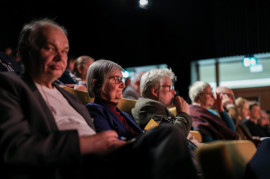
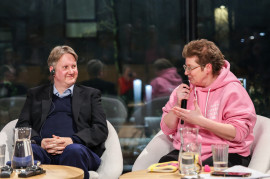
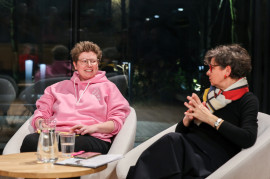

How did the debate’s participants respond to the research findings? What other “blind spots” and asymmetries exist in Polish-German dialogue? How do participants from Germany comment on Germany’s Ostpolitik in recent years, and how do they assess Poland’s soft power? We invite you to watch the video recording of the more than two-hour debate.
Participants in the discussion:
Sebastian Christ – journalist, writer, and futurologist. He is the author of the first publication devoted to Otto Küsel, a German criminal prisoner in KL Auschwitz who contributed to saving hundreds of Polish inmates. He worked as a parliamentary reporter for stern.de, a digital policy editor at “Der Tagesspiegel”, and as a war correspondent in Afghanistan and Iraq. He spent a year living in Kyiv, conducting research on the Maidan movement. From 2021 to 2023, he served as a Senior Communications Expert at the Cyber Innovation Hub of the Bundeswehr. He has received numerous awards for his journalistic and publicist work, including the Axel Springer Award twice.
Philipp Fritz – German journalist, correspondent for “Die Welt” and “Welt am Sonntag”. He specializes in reporting on political and social developments in Poland, Ukraine, and the Baltic states. He has also published in “Berliner Zeitung”, “Die Zeit”, and “Gazeta Wyborcza”. He studied political science, cultural studies, and Eastern European studies in Germany and Poland. In 2024, he was a Marcin Król Fellow at Visegrad Insight.
Hanna Radziejowska – coordinator, curator, producer, and writer of cultural and museum projects. Head of the Berlin branch of the Pilecki Institute. Graduate of the Institute of History at the University of Warsaw. She has worked in Warsaw’s cultural institutions and municipal administration, including the Warsaw Rising Museum, the History Meeting House, the Copernicus Science Center, the City of Warsaw Office, and the Museum of Warsaw (Head of the Wola Museum). From June 2017 to February 2018, she served as Director of the Polish Institute in Berlin.
Dr. Anna Kwiatkowska – founder and head of the German Desk at the Center for Eastern Studies (currently the Department for Germany and Northern Europe). Together with Prof. Marek Cichocki, she co-creates the podcast “Niemcy w ruinie?” She holds a PhD in social sciences in the field of political science. She is a member of the Scientific Council of the European Network Remembrance and Solidarity. She collaborates with “Dziennik Gazeta Prawna” and “Tygodnik Powszechny”.
Dr. Aleksandra Burdziej – literary scholar and Germanist. Her research addresses cultural memory, among other topics. She analyzes ways of representing 20th-century experiences in literature and contemporary culture. She studied in Poland, Germany, and Austria. She is academically affiliated with Nicolaus Copernicus University in Toruń. She combines academic work with social and expert engagement, collaborating with institutions in Poland and abroad to promote intercultural dialogue and civil society. She is President of the National Association of Polish-German Societies, as well as the initiator and organizer of numerous Polish-German dialogue projects.
About the Series
“Berlin in Warsaw” is a monthly series of debates, seminars and author meetings held at the Pilecki Institute, featuring Polish and German experts. We bring the most important contemporary German public debates on memory, history, and politics to Warsaw, confronting them with Polish perspectives and experience.
We create a space for conversations that are difficult but crucial for Polish-German relations. In a time of rapid change in Europe and around the world, our goal is to sustain open spaces for dialogue – spaces where differences can exist, and yet sincere conversation can continue.
The media partners for the “Berlin in Warsaw” series are “Rzeczpospolita” and rp.pl.

See also
- Previously unpublished German archival materials from France’s ECPAD at the Pilecki Institute and the Warsaw Rising Museum
News
Previously unpublished German archival materials from France’s ECPAD at the Pilecki Institute and the Warsaw Rising Museum
The Witold Pilecki Institute of Solidarity and Valor and the Warsaw Rising Museum have signed a strategic trilateral cooperation agreement with ECPAD (Établissement de Communication et de Production Audiovisuelle de la Défense / Defense Communication and Audiovisual Production Center), the French military audiovisual archive based in Ivry-sur-Seine, France. The agreement gives the Polish institutions access to unique Second World War photographs previously unseen in Poland, opens access to the vast holdings of the French archive, and launches a partnership of major significance for research into Polish history.
- „Soviet Central Asia as a Totalitarian Testing Ground” - international academic conference
News
„Soviet Central Asia as a Totalitarian Testing Ground” - international academic conference
Three days, dozens of presentations, and researchers from Poland and abroad summed up the international academic conference held at the Pilecki Institute in Warsaw on 2–4 September.
- The hitherto unknown memoirs of a German official from occupied Poland have been donated to the Pilecki Institute
News
The hitherto unknown memoirs of a German official from occupied Poland have been donated to the Pilecki Institute
A unique document has been added to the Pilecki Institute’s archives: the previously unpublished and unknown memoirs of a German official who worked in the civil administration of the General Government during the Second World War.
- Evil Woven into Everyday Life | Dr Joanna Nikel on the Memoirs of a German Official from His Stay in the General Government
News
Evil Woven into Everyday Life | Dr Joanna Nikel on the Memoirs of a German Official from His Stay in the General Government
"It is rare for a document to find its way into archival collections in which the voice of an official of the occupation apparatus himself – written down without any intention of accusation, and even stressing his own sense of normality – becomes one of the most eloquent testimonies to the criminal nature of the system he served", writes Dr Joanna Nikel in her initial commentary on the materials received by the Pilecki Institute.
- 14 books nominated for this year’s Witold Pilecki International Book Award
News
14 books nominated for this year’s Witold Pilecki International Book Award
On Saturday, 5 September, at the Autumn Book Fair in Warsaw, the Pilecki Institute announced the titles and authors of 14 books nominated for this year’s Witold Pilecki International Book Award.
- New Jork | Exhibition: Between Life and Death. Stories of Rescue during the Holocaust
News
New Jork | Exhibition: Between Life and Death. Stories of Rescue during the Holocaust
Through October 29, the Pilecki Institute in New York is hosting an exhibition about the people who risked their own lives to save Jews during the Holocaust—and those who survived thanks to their courage.
- „Soviet Central Asia as a Totalitarian Testing Ground” - international academic conference
News
„Soviet Central Asia as a Totalitarian Testing Ground” - international academic conference
The international academic conference organized by the Pilecki Institute is the first initiative in Poland to bring together interdisciplinary research on Soviet Central Asia, a region with an exceptionally complex history of totalitarianism, mass repression, and forced deportations, that also include the experiences of Poles.
- Karol Madaj appointed Director of the Witold Pilecki Institute of Solidarity and Valor
News
Karol Madaj appointed Director of the Witold Pilecki Institute of Solidarity and Valor
Marta Cienkowska, the Minister of Culture and National Heritage, has appointed Karol Madaj Director of the Witold Pilecki Institute of Solidarity and Valor in Warsaw. His five-year term will begin on 30 August 2026. From 1 September 2025, Karol Madaj served as the acting director of the Pilecki Institute.
- Hacker attack on the websites of the Pilecki Institute in Warsaw, Berlin, and Augustów
News
Hacker attack on the websites of the Pilecki Institute in Warsaw, Berlin, and Augustów
On the night of August 13–14 our websites suffered another serious hacking attack. Content bearing the hallmarks of Russian propaganda and disinformation — targeting Polish history and reinforcing anti-Ukrainian narratives — was deliberately placed on the Institute's pages devoted to Augustów, Berlin, and Warsaw.
- Academic conference “Oppositional Engagement of Women in Authoritarian and Totalitarian Systems of the 20th Century: Poland in a Comparative European Perspective (1919–1989)”
News
Academic conference “Oppositional Engagement of Women in Authoritarian and Totalitarian Systems of the 20th Century: Poland in a Comparative European Perspective (1919–1989)”
The second academic conference in a series “Oppositional Engagement of Women in Authoritarian and Totalitarian Systems of the 20th Century: Poland in a Comparative European Perspective (1919–1989)” brought together representatives of various fields of the humanities and social sciences from numerous research centers in Poland and abroad.
- Accountability for War Crimes. New book from Pilecki's expert
News
Accountability for War Crimes. New book from Pilecki's expert
It is an expanded English-language edition of the monograph "Problem odpowiedzialności karnej za zbrodnie wojenne w pracach rządu polskiego na emigracji (1939–1945)", which in 2023 was awarded a grant under the Ministry of Science and Higher Education’s “Excellent Science II” program for the translation and open-access publication of the book abroad.
- 12 July | Day of Remembrance for the Victims of the Augustów Roundup
News
12 July | Day of Remembrance for the Victims of the Augustów Roundup
12 July is celebrated as the National Day of Remembrance for the Victims of the Augustów Roundup. The roundup began 81 years ago on this day – on 12 July 1945, two months after the end of the Second World War.