Mateusz Bronisław Stawarski - Instytut Pileckiego
Mateusz Bronisław Stawarski (1903–1942)
Commemorated in 2026.
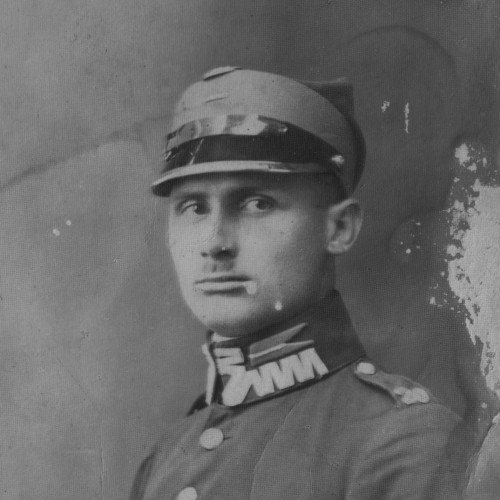
Commemorated on 24 March 2026 in Sieniawa (Podkarpackie region).
Mateusz Bronisław Stawarski lived in Sieniawa with his wife Wiktoria and their three children: Stanisław Bohdan, Jerzy, and Krystyna Wanda. In 1942, the Singer family, a married couple with three children known to Wiktoria from before the war, approached the Stawarskis for help.
A hiding place behind the wall
Mateusz Stawarski created a hiding place for the Singers in his own home by partitioning off part of a room with a wall. The entrance was located in the attic, concealed beneath a trunk. The house containing the hiding place stood right on the boundary of the ghetto, in an area patrolled by gendarmes and Ukrainian police. To reduce the risk, the Stawarskis moved to a rented house across the street, and only their eldest son, Stanisław, maintained contact with the hiding place by delivering food prepared by Wiktoria. Mateusz, fearing the danger associated with helping Jews, spent nights away from the hiding place, at his mother’s home.
Repression and growing danger
In the autumn of 1942, the German occupiers murdered between 600 and 1,500 people from the Sieniawa ghetto and nearby towns. Individuals were also captured in the town and surrounding villages and killed by members of the occupying police formations. Hiding the Singer family turned into a prolonged struggle against the fear of discovery. Concerned for his family’s safety, Mateusz sought to find a hiding place for the Singers outside the town. Ultimately, the Jews, likely in agreement with the Stawarskis, arranged a new hiding place near the villages of Dobra and Wylewa, where they had earlier moved part of their property.
The tragic fate of the Singer family
After leaving the Stawarskis’ hiding place, Singer and two of the children disappeared under unknown circumstances. Some time later, Singer’s wife appeared at the Stawarskis’ home with one child. They were captured by German gendarmes and shot. A rumor spread through the town that the woman had confessed that the Stawarskis had been hiding her family.
Arrest
Around 23 December 1942, Karl Seidel, a sergeant of the German gendarmerie in Sieniawa, arrested Mateusz Stawarski. Wiktoria went to the station in an attempt to rescue him and was also arrested.
Farewell letter
“My dearest Mother, […] and you, Cenia, with your Father. I have one last request of you: take the little ones, Wandeczka, and Jeżyk, and Bohdan – take in these orphans, keep them safe as best you can. I beg you, I implore you, take in these little ones […] be a father and mother to them. Mother, you know that I have always been unfortunate, and when I am gone, take Wandeczka in your arms and hold her to your heart and stroke her, and let it seem that it is I who am doing so”, Mateusz Stawarski wrote to his loved ones [Letter (smuggled note) of Mateusz Bronisław from the detention center in Sieniawa, 23–26 December 1942. Private archive of the Stawarski family].
Execution
On 26 December, Mateusz Bronisław Stawarski was shot in the Głażyna forest for having aided Jews. According to accounts, the execution was carried out by Seidel and one of the Ukrainian policemen. After the war, the family exhumed Mateusz Stawarski and buried him in the cemetery in Sieniawa. His body was identified by a rosary that had been given to him in prison by his family.
Commemoration
Mateusz Bronisław Stawarski and his wife Wiktoria were commemorated as part of the “Called by Name” program on 24 March 2026 in Sieniawa (Podkarpackie region). A report from the ceremony is available at the link below.
Photograph: Rzeszów, 1926, Mateusz Bronisław Stawarski as a soldier of the Polish Army. Private archive of the Stawarski family.