In Search of Identity: The Post-War Reconstruction of Gdańsk and Szczecin and its Contemporary Echoes - Instytut Pileckiego

debate
22.05.2025 (Thu) 18:30
In Search of Identity: The Post-War Reconstruction of Gdańsk and Szczecin and its Contemporary Echoes
After World War II, Gdańsk and Szczecin underwent extensive reconstruction to forge new identities. Today, their contemporary architecture reflects both the legacy of those postwar efforts and the evolving perceptions of urban identity.
A new Exercising Modernity Event!
Pilecki-Institut Berlin, Pariser Platz 4a
Organizers: Pilecki-Institut Berlin, DOM Publishers
Registration: https://forms.gle/8tc7tWCbtEfU76nd6
Panel discussion featuring:
- Dr. Jakub Gołębiewski, West Pomeranian University of Technology
- Dr. Justyna Borucka, Gdańsk University of Technology
- Prof. Uta Pottgiesser, Delft University of Technology
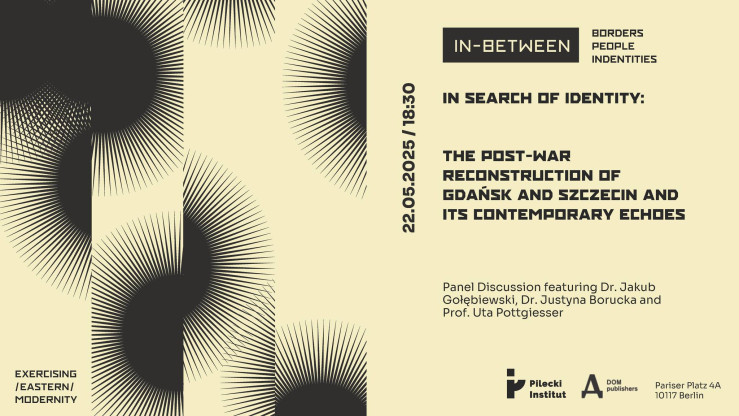
Gdańsk and Szczecin are two port cities whose urban planning and architecture reflect the complex and turbulent history of twentieth-century Europe. After the end of World War II, both cities underwent a change in national affiliation, accompanied by a complete exchange of populations. The new inhabitants faced the task of rebuilding and redefining a space that was unfamiliar to them. This initiated a process of becoming acquainted with a foreign land, putting down roots, and constructing a new narrative—one that also found expression in architecture.
In determining the form and scale of reconstruction, efforts were made to highlight significant elements of the existing cultural landscape, underlining the historical connection of both cities to the Polish state. The change in the political system—especially the nationalisation of property—enabled a comprehensive, top-down approach to spatial development, which in turn had a considerable impact on the reconstruction process.
Yet despite these commonalities, the reconstruction of Gdańsk and Szczecin followed notably different paths. Gdańsk focused on recreating the historical character of buildings in its old town, whereas Szczecin chose to incorporate contemporary architecture into the same context. These decisions left a lasting imprint on the spatial development of both cities, the consequences of which remain visible today.
At our event, we aim to reflect on how today’s generations relate to the legacy of post-war reconstruction and modernisation, and how the processes described above are now assessed in both cities. Has the attempt to create a new post-war identity stood the test of time in the face of a renewed longing for the past and for the pre-war image of these cities? How are the principles established back then being redefined in the context of ongoing urban development and densification? And finally: What does contemporary architecture in Gdańsk and Szczecin reveal about current perceptions of the cities’ identities?
See also
- Conference “Shared Experiences – Different Paths? The Turning Point of 1956 and Its Significance for the Countries and Societies of East Central Europe”
Event
Conference “Shared Experiences – Different Paths? The Turning Point of 1956 and Its Significance for the Countries and Societies of East Central Europe”
The Pilecki Institute and the Tadeusz Manteuffel Institute of History of the Polish Academy of Sciences invite you to participate in an international academic conference, Shared Experiences – Different Paths? The Turning Point of 1956 and Its Significance for the Countries and Societies of East Central Europe, which will be held on 19–21 October 2026 in Warsaw. The event is part of a series of conferences devoted to the history of transformations in East Central Europe after 1945.
- New Jork | The Augustów Roundup – the largest Soviet crime committed against Polish citizens after World War II. Workshops and Presentations
Event
New Jork | The Augustów Roundup – the largest Soviet crime committed against Polish citizens after World War II. Workshops and Presentations
Learn the history of the Augustów Roundup, a Soviet operation carried out in July 1945 that resulted in the arrest and disappearance of hundreds of people.
- 80th Anniversary of the Nuremberg Judgment | Master lecture by Prof. William Schabas and an international discussion panel
lecture
80th Anniversary of the Nuremberg Judgment | Master lecture by Prof. William Schabas and an international discussion panel
– “1 October 2026 marks the 80th anniversary of the Judgment of the International Military Tribunal (IMT) at Nuremberg, which was a watershed moment for the development of international criminal law.” – emphasized Dr. Dominika Uczkiewicz from the Pilecki Institute.