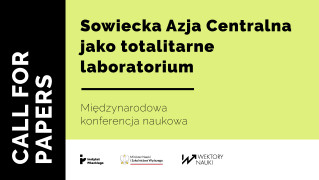
CALL FOR PAPERS: International academic conference „Soviet Central Asia as a Totalitarian Testing Ground” | Deadline for submissions: July 15 - Instytut Pileckiego

conference
15.07.2026 (Wed) 15:00
CALL FOR PAPERS: International academic conference „Soviet Central Asia as a Totalitarian Testing Ground” | Deadline for submissions: July 15
The Pilecki Institute in Warsaw invites scholars to take part in the international academic conference “Soviet Central Asia as a Totalitarian Testing Ground”, to be held on 2-4 September 2026 at the Institute’s headquarters in Warsaw.
International academic conference “Soviet Central Asia as a Totalitarian Testing Ground”
September 2–4 2026
Instytut Pileckiego, 82 Sienna Street, Warsaw
CALL FOR PAPERS
The call for participation applies both to proposals for complete panels and to individual papers. The organizers invite researchers from Poland and abroad whose work addresses 20th-century Central Asia, the functioning of the Soviet system in the region, and the fate of the civilian population in the 20th century, including both indigenous communities and those resettled as a result of deportations. The conference is intended not only to present the latest research findings, but also to foster international scholarly cooperation and to initiate new research projects on communist totalitarianism in the countries of Central Asia, as well as to encourage deeper reflection on the nature of Russian-Soviet colonialism, its legacy, and forms of remembrance of its victims.
The organizers intend for the conference to analyze the instruments of Soviet repression, including mass deportations of selected social groups and entire nations, “dekulakization” campaigns, ethnic purges, famine as a tool of Sovietization and of “uprooting social remnants,” the functioning of the GULAG system, forced collectivization, policies aimed at the extermination of local elites, the destruction of religious and national structures, and the permanent control and indoctrination exercised by the party apparatus, the NKVD/KGB, and related institutions. The conference should also take into account the diversity of national experiences, enable comparisons of models of resistance and survival, and examine forms of adaptation and everyday functioning within the Soviet universe. An important element of the conference will be reflection on the responses of communities affected by terror and Soviet social engineering in their social, economic, and religious dimensions.
The year 2026 marks several important anniversaries connected with the history of Soviet Central Asia, namely the 100th anniversary of the first Soviet census, which initiated the process of creating the “Soviet nations” of Central Asia, the 90th anniversary of the deportations of the Polish and German populations from Soviet Ukraine, and the 40th anniversary of the December events in the Kazakh Soviet Socialist Republic, which constituted an expression of national awakening. The organizers wish these dates to serve as a thematic focal point of the proceedings, at least symbolically.
The international academic conference organized by the Pilecki Institute is the first initiative in Poland to bring together interdisciplinary research on Soviet Central Asia, a region with an exceptionally complex history of totalitarianism, mass repression, and forced deportations that also include the experiences of Poles. To date, research in Poland has focused on isolated aspects of the subject, such as documentation of repression, ethnographic studies, or political science analyses related to global security. There remains a significant gap in comprehensive approaches to socio-cultural processes and to the mechanisms of adaptation and survival among deported and indigenous communities in the region.
The aim of the conference is to create a platform for the exchange of knowledge among scholars representing various disciplines, including Soviet studies, anthropology, history, political science, and cultural studies. The meeting is intended to facilitate the sharing of experiences and the establishment of lasting cooperation between Polish and international research centers, including academic institutions and archives in Central Asia.
From a long-term perspective, the conference is intended to contribute to opening access to local sources and to the implementation of joint research projects devoted to the history of totalitarianism and collective memory. One of its aims is also to help preserve and disseminate knowledge about the victims of Soviet totalitarianism in Central Asia among various national communities whose tragic fates remained for decades marginalized, distorted, or erased. We seek to ensure that the meeting becomes a forum in which research results from different countries, disciplines, and methodological perspectives are brought together, including history, political science, law, sociology, cultural anthropology, and memory studies. This approach will allow for a better understanding of the nature of systemic violence and its long-term consequences for national and European identity. We are particularly interested in bringing together papers and panels that address both the macrohistorical dimension, such as state policy and mass repressive operations, and the microhistorical aspects, such as the experiences of individuals, families, and local communities.
Academic partners: Institute of Ethnology and Cultural Anthropology, University of Warsaw; Institute of Political Studies of the Polish Academy of Sciences (Pipes Laboratory); Museum of the Second World War; Sybir Memorial Museum; Center for Central Asian Studies, Adam Mickiewicz University; Faculty of “Artes Liberales”, University of Warsaw.
Proposed topics and thematic areas:
1. Western, Central European, global, and Polish Soviet studies on Soviet Central Asia. An assessment after decades of research: clichés and stereotypes, or valuable observations and forecasts? An attempt to answer questions such as whether material from Central Asia contributes anything new to our understanding of totalitarian systems, and whether the application of the modern versus premodern societies dichotomy is meaningful in this context.
2. Comparative “diasporology” of nations deported to Central Asia from an anthropological perspective, including Poles, Germans, Koreans, Greeks, peoples of the Caucasus, and others. Topics include adaptation strategies, settlement patterns, levels of education, employment paradigms, mixed marriages, position within the unofficial Soviet hierarchy, “mythological niches”, structures of everyday life, family and household models, demography, participation in the “grey zone”, involvement in the Soviet public sphere, and refugee communities formed by free choice as a contrast to deported populations.
3. Coming to terms with the Soviet past in Central Asia, with particular attention to the State Commission for the Full Rehabilitation of Victims of Political Repression and Famine in Kazakhstan. An assessment of its activities, achievements, and shortcomings. Is it a valuable model for neighboring countries in the region? What significance does its work hold for researchers from Poland?
4. The collective farm versus the household plot as a distinctive feature of Soviet Central Asia, approached from anthropological and economic perspectives. Topics include typologies of collective farms, the planned economy versus the “grey zone”, the collective farm as a “new tribe”, social mobility in rural areas, resettlements, the collective farm in Soviet ethnography, and an overall assessment of the Central Asian collective farm in comparison with its counterparts in other regions of the USSR.
5. “Ecumenism” after the GULAG, Soviet Central Asia as a meeting place of world religions. Issues include “official” religiosity versus the religious underground, the role of women in religious life, confessional hierarchies versus ecumenism, transformations of religiosity in response to Soviet policy, the possible triumph of “popular religion”, organizational structures, and the profile of the believer.
Conference languages: English and Russian, with Polish permitted in exceptional cases.
Keynote lecturers:
Manara Kalybekova, Deputy Director at the Institute of History and Ethnology of the Ch.Ch. Valikhanov Kazakh Academy of Sciences, and the author of more than 60 publications devoted to Soviet repression and the history of Poles in Kazakhstan. She has been awarded the Bene Merito honorary distinction for activities strengthening Poland’s position on the international stage.
Renat Bekkin, currently an independent researcher. He is the founder and long-time head of the Department of Islamic Studies at Kazan Federal University, as well as the founder and editor-in-chief of the academic journal “Kazan Islamic Review”. He is the author of 14 monographs, more than 100 scholarly articles, and three novels.
Alibek Tabuldenov, Dean of the Faculty of Social Sciences and Humanities at the Akhmet Baitursynov Kostanay Regional University, previously Director of the P. Chuzhinov Institute of Economics and Law. He is the author of several dozen publications devoted to the participation of deported nations in the socio-economic life of Kazakhstan.
Proposals containing an abstract of up to 300 words for an individual paper or up to 500 words for a panel proposal, along with personal details, institutional affiliations, and information regarding potential support for visa applications, should be sent via email to konferencja.azja.centralna@instytutpileckiego.pl by 15 July 2026. The organizers reserve the right to select topics from among the submitted proposals and will inform applicants of their decision by 30 July 2026.
A symbolic conference fee is planned, from which members of the organizing committee will be exempt. Participants from countries of the former USSR may apply for a waiver of the fee, as well as for full or partial reimbursement of travel costs.
The project is financed from the state budget, allocated by the Minister of Science and Higher Education as part of the Vectors of Science program.
See also
- Call for Papers | Exile Governments and Political Refugees in 20th-Century Europe: Sovereignty in the Face of Totalitarianisms (Deadline: November 15)
conference
Call for Papers | Exile Governments and Political Refugees in 20th-Century Europe: Sovereignty in the Face of Totalitarianisms (Deadline: November 15)
The year 2027 marks the 85th anniversary of the signing, on 13 January 1942, of the Declaration of St James’s Palace on the Punishment of War Crimes. To commemorate this landmark event, we are organising an international academic conference addressing the history and significance of governments in exile and political refugees in 20th-century Europe.
- Conference “Shared Experiences – Different Paths? The Turning Point of 1956 and Its Significance for the Countries and Societies of East Central Europe”
conference
Conference “Shared Experiences – Different Paths? The Turning Point of 1956 and Its Significance for the Countries and Societies of East Central Europe”
The Pilecki Institute and the Tadeusz Manteuffel Institute of History of the Polish Academy of Sciences invite you to participate in an international academic conference, Shared Experiences – Different Paths? The Turning Point of 1956 and Its Significance for the Countries and Societies of East Central Europe, which will be held on 19–21 October 2026 in Warsaw. The event is part of a series of conferences devoted to the history of transformations in East Central Europe after 1945.
- New Jork | The Augustów Roundup – the largest Soviet crime committed against Polish citizens after World War II. Workshops and Presentations
Event
New Jork | The Augustów Roundup – the largest Soviet crime committed against Polish citizens after World War II. Workshops and Presentations
Learn the history of the Augustów Roundup, a Soviet operation carried out in July 1945 that resulted in the arrest and disappearance of hundreds of people.