The Premiere of the “Passports to Life” Exhibition in Israel - Instytut Pileckiego

16.12.2019 (Mon)
The Premiere of the “Passports to Life” Exhibition in Israel
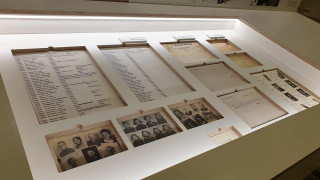
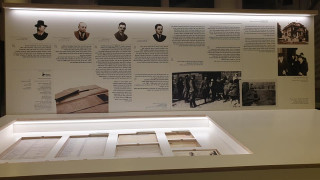
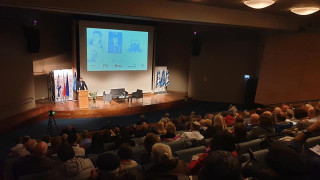
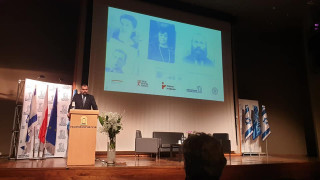
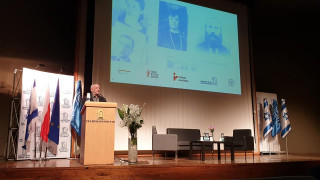
Acting in cooperation with the Polish Institute in Tel Aviv, the Pilecki Institute organized an exhibition entitled “Passports to Life” about the group headed by Aleksander Ładoś. The exposition can be viewed at the Menachem Begin Heritage Center.
It comprises reproductions of passports, documents, photographs, letters and other correspondence from the Chaim Eiss Archive. These document copies were made from originals which are held in the archives of the Auschwitz-Birkenau State Museum.
– The exhibition in Jerusalem, along with our most recent publication, will allow us to present the scale of activities of the so-called Ładoś Group, which remains relatively unknown. The Group itself was made up of Polish diplomats based in Switzerland who conducted a secret operation which succeeded in saving the lives of thousands of Jews – sentenced to perish in the Nazi Holocaust that engulfed the countries of occupied Europe, among them Poland. Purchases were made of original empty forms issued by certain Latin American states, which were then falsified at the Legation of the Republic of Poland in Bern. The ready passports were smuggled to various locations, including ghettos, to buy time and improve chances of survival for people who would otherwise have assuredly been murdered in the German death camps – said Eryk Habowski, the Chief Expert of the Pilecki Institute.
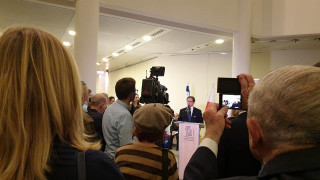
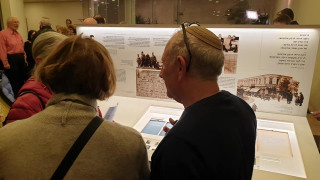
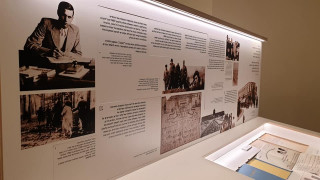
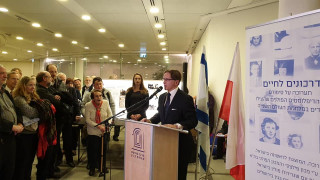
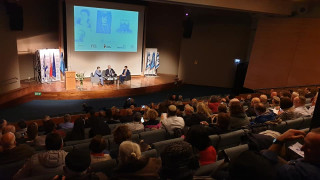
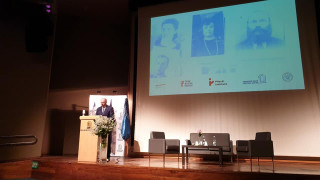
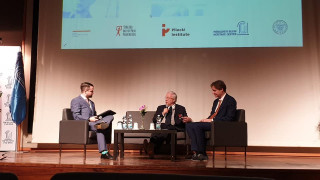
The opening of the exhibition, which took place on Sunday, 15 December, was attended by, among others, Marek Magierowski – the Ambassador of the Republic of Poland to Israel, Jakub Kumoch – the Ambassador of the Republic of Poland to Switzerland, Markus Blechner – the Honorary Consul of the Republic of Poland in Zurich, Herzl Makov – the Director of the Menachem Begin Heritage Center, Anna Gutkowska – the Deputy Director of the Pilecki Institute, Mateusz Szpytma – the Deputy President of the Institute of National Remembrance, and Agnieszka Jędrzak – the Head of the International Section at the Office of the President of the Institute of National Remembrance. Eryk Habowski, the Chief Expert of the Pilecki Institute, gave a talk on the occasion, focusing on the activities of Aleksander Ładoś and the Polish Government-in-Exile. It was followed by a discussion panel with the participation of Markus Blechner and John Cornell from the Pilecki Institute. The meeting was chaired by Patrick Ney.
The “Passports to Life” exhibition is in Hebrew and will run until 5 February 2020. Entrance is free of charge.
The Activities of Aleksander Ładoś
Ambassador Ładoś, who during World War II served the Polish Government-in-Exile as its representative in Switzerland, instructed his personnel to falsify documents issued by third countries in an attempt to save at least some of Poland’s Jewish community. The “Ładoś passports” were intended to rescue their bearers from the Holocaust. The documents were sent to ghettos and camps throughout occupied Poland and Holland, and also to a great number of citizens of other European countries. Nearly one half of the papers certifying Paraguayan citizenship were forged by Konstanty Rokicki, the Vice-Consul, while the remainder were probably authored by Stefan Ryniewicz with the help of an embassy employee, Julisz Kühl. Some of the documents, passports and certifications of citizenship of Honduras, Haiti and Peru were purchased with the Ambassador’s consent by two Jewish activists, Abraham Silberschein and Chaim Eiss, who were also members of the Group. The entire operation received the support of the Polish government, which pressured representatives of Latin American states to recognize the falsified documents for humanitarian reasons.
In December 2019, the Pilecki Institute issued “The Ładoś list. A register of persons in whose names the Legation of the Republic of Poland and Jewish organizations in Switzerland made out Latin American passports during World War II”. The publication, which enumerates 3,262 people who benefited from the operation and whose identities have been determined to date, is the result of research performed by employees of the Polish Embassy in Bern and the Pilecki Institute with the support of experts from the Institute of National Remembrance, the Jewish Historical Institute and the Auschwitz-Birkenau State Museum.
See also
- Previously unpublished German archival materials from France’s ECPAD at the Pilecki Institute and the Warsaw Rising Museum
News
Previously unpublished German archival materials from France’s ECPAD at the Pilecki Institute and the Warsaw Rising Museum
The Witold Pilecki Institute of Solidarity and Valor and the Warsaw Rising Museum have signed a strategic trilateral cooperation agreement with ECPAD (Établissement de Communication et de Production Audiovisuelle de la Défense / Defense Communication and Audiovisual Production Center), the French military audiovisual archive based in Ivry-sur-Seine, France. The agreement gives the Polish institutions access to unique Second World War photographs previously unseen in Poland, opens access to the vast holdings of the French archive, and launches a partnership of major significance for research into Polish history.
- „Soviet Central Asia as a Totalitarian Testing Ground” - international academic conference
News
„Soviet Central Asia as a Totalitarian Testing Ground” - international academic conference
Three days, dozens of presentations, and researchers from Poland and abroad summed up the international academic conference held at the Pilecki Institute in Warsaw on 2–4 September.
- The hitherto unknown memoirs of a German official from occupied Poland have been donated to the Pilecki Institute
News
The hitherto unknown memoirs of a German official from occupied Poland have been donated to the Pilecki Institute
A unique document has been added to the Pilecki Institute’s archives: the previously unpublished and unknown memoirs of a German official who worked in the civil administration of the General Government during the Second World War.
- Evil Woven into Everyday Life | Dr Joanna Nikel on the Memoirs of a German Official from His Stay in the General Government
News
Evil Woven into Everyday Life | Dr Joanna Nikel on the Memoirs of a German Official from His Stay in the General Government
"It is rare for a document to find its way into archival collections in which the voice of an official of the occupation apparatus himself – written down without any intention of accusation, and even stressing his own sense of normality – becomes one of the most eloquent testimonies to the criminal nature of the system he served", writes Dr Joanna Nikel in her initial commentary on the materials received by the Pilecki Institute.
- 14 books nominated for this year’s Witold Pilecki International Book Award
News
14 books nominated for this year’s Witold Pilecki International Book Award
On Saturday, 5 September, at the Autumn Book Fair in Warsaw, the Pilecki Institute announced the titles and authors of 14 books nominated for this year’s Witold Pilecki International Book Award.
- New Jork | Exhibition: Between Life and Death. Stories of Rescue during the Holocaust
News
New Jork | Exhibition: Between Life and Death. Stories of Rescue during the Holocaust
Through October 29, the Pilecki Institute in New York is hosting an exhibition about the people who risked their own lives to save Jews during the Holocaust—and those who survived thanks to their courage.
- „Soviet Central Asia as a Totalitarian Testing Ground” - international academic conference
News
„Soviet Central Asia as a Totalitarian Testing Ground” - international academic conference
The international academic conference organized by the Pilecki Institute is the first initiative in Poland to bring together interdisciplinary research on Soviet Central Asia, a region with an exceptionally complex history of totalitarianism, mass repression, and forced deportations, that also include the experiences of Poles.
- Karol Madaj appointed Director of the Witold Pilecki Institute of Solidarity and Valor
News
Karol Madaj appointed Director of the Witold Pilecki Institute of Solidarity and Valor
Marta Cienkowska, the Minister of Culture and National Heritage, has appointed Karol Madaj Director of the Witold Pilecki Institute of Solidarity and Valor in Warsaw. His five-year term will begin on 30 August 2026. From 1 September 2025, Karol Madaj served as the acting director of the Pilecki Institute.
- Hacker attack on the websites of the Pilecki Institute in Warsaw, Berlin, and Augustów
News
Hacker attack on the websites of the Pilecki Institute in Warsaw, Berlin, and Augustów
On the night of August 13–14 our websites suffered another serious hacking attack. Content bearing the hallmarks of Russian propaganda and disinformation — targeting Polish history and reinforcing anti-Ukrainian narratives — was deliberately placed on the Institute's pages devoted to Augustów, Berlin, and Warsaw.
- Academic conference “Oppositional Engagement of Women in Authoritarian and Totalitarian Systems of the 20th Century: Poland in a Comparative European Perspective (1919–1989)”
News
Academic conference “Oppositional Engagement of Women in Authoritarian and Totalitarian Systems of the 20th Century: Poland in a Comparative European Perspective (1919–1989)”
The second academic conference in a series “Oppositional Engagement of Women in Authoritarian and Totalitarian Systems of the 20th Century: Poland in a Comparative European Perspective (1919–1989)” brought together representatives of various fields of the humanities and social sciences from numerous research centers in Poland and abroad.
- Accountability for War Crimes. New book from Pilecki's expert
News
Accountability for War Crimes. New book from Pilecki's expert
It is an expanded English-language edition of the monograph "Problem odpowiedzialności karnej za zbrodnie wojenne w pracach rządu polskiego na emigracji (1939–1945)", which in 2023 was awarded a grant under the Ministry of Science and Higher Education’s “Excellent Science II” program for the translation and open-access publication of the book abroad.
- 12 July | Day of Remembrance for the Victims of the Augustów Roundup
News
12 July | Day of Remembrance for the Victims of the Augustów Roundup
12 July is celebrated as the National Day of Remembrance for the Victims of the Augustów Roundup. The roundup began 81 years ago on this day – on 12 July 1945, two months after the end of the Second World War.