The Second International Congress of the Pilecki Institute: A recap - Instytut Pileckiego

22.10.2026 (Thu)
The Second International Congress of the Pilecki Institute: A recap
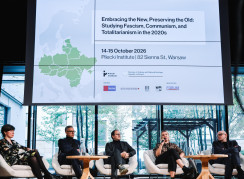
Congress “Embracing the New, Preserving the Old: Studying Fascism, Communism, and Totalitarianism in the 2020s” took place on October 14 and 15, 2026 – two packed days of stimulating papers, keynote events, debates and discussions.

“Embracing the New, Preserving the Old: Studying Fascism, Communism, and Totalitarianism in the 2020s”, 14-15 October, 2026
The topic of the congress aimed to open the floor to invigorating debate over the methods and assumptions governing how we approach these fundamental forces of 20th-century Eastern and East-Central European history. The rapid development of new tools and technologies such as AI, as well as new techniques and sources, brings us to consider how the new can be aligned with the old. At the same time the alarming rise of authoritarianism, extremism, and wars of aggression remind us of how important concepts such as fascism and totalitarianism are to understanding not only the past, but the present as well.
Sixty-four presentations covered an immense range of topics that may have centered around our region in the mid-20th century, but which included studies of the Global South and its ties to communist Europe, developments in the inter-war period and early fascist movements, and fascist or authoritarian turns in Britain and the United States.
While many papers treated totalitarianism, fascism, and communism through historical topics, others considered how these apply to current events and what past models can bring to understanding present-day conflicts. A number of papers treated these subjects through questions of theory and methodology, seeking to clarify how terms such as totalitarianism or fascism were developed in the past and how we should employ them today. Presentations reflected moreover the vast array of disciplines and branches through which these topics are studied, which include museology, cultural history, literary studies, archival practices, and film studies along with political science, sociology, and historiography.
Keynote lectures
Two outstanding keynote lectures given by Professors Juliane Fürst from the Leibnitz Center for Contemporary History and John Connelly from the University of California, Berkeley brought an important focus to the congress.

While Juliane Fürst looked to the present and future of Soviet studies in the light of Russia’s current war against Ukraine, raising questions about our assumptions and approaches, John Connelly looked to the distant past of the two principal totalitarian regimes – Nazi Germany and the Soviet Union – to plumb a more nuanced understanding of their deep imperial roots and how these shaped their later (and, in the case of Russia, current) aspirations.

Keynote discussion
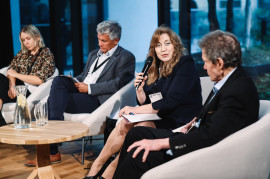
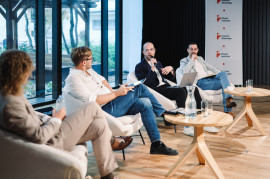
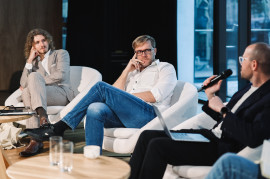
A concluding keynote discussion brought together five distinguished scholars from the United States, Bulgaria, Romania, Poland, and Czechia: Anca Diana Axinia, Nadia Boyadjieva, Mark Kramer, Aviezer Tucker, and Michał Wawrzonek. Bringing the congress’s many threads back to questions of sources and methods, these scholars discussed the many avenues of archival research still open to researchers – despite current conflicts – and the many challenges to and opportunities for future work in the study of this region and of the effects of fascism, communism, and totalitarianism upon it.

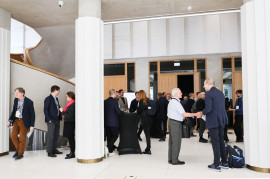
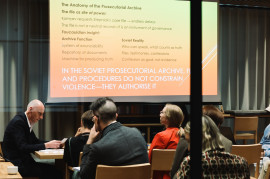
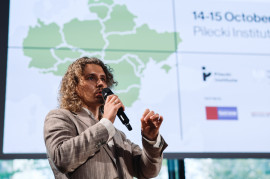
We invite you to view the photo gallery from the congress.
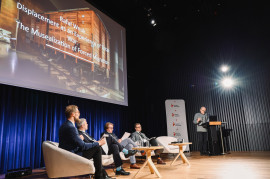
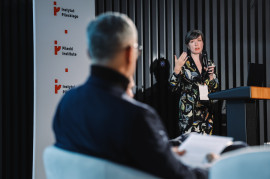
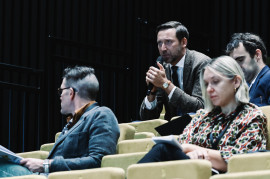
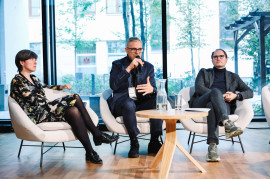
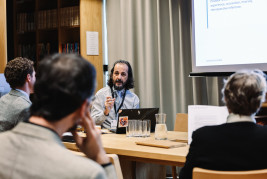
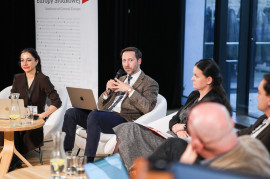
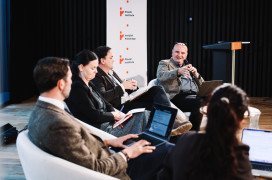
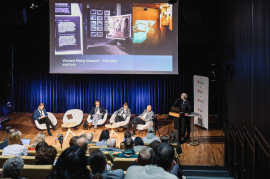
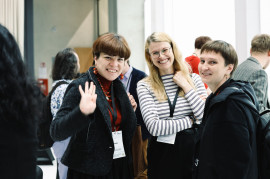
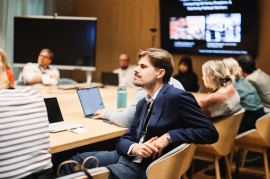
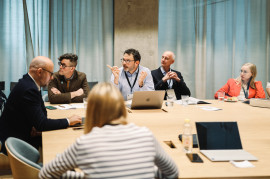
You can still visit the conference website (click here).
The video recording of the congress is now available to watch.
The Contemporary History of Writing Soviet & Post-Soviet History – Juliane Fürst (Keynote Address)
The Musealization of Forced Migrations in Poland (Session I-a)
20th Century Fascism & Totalitarianism: Legacies & Challenges Today (Keynote Discussion)
Unexplored Origins of Totalitarianism – John Connelly (Keynote Address)
Remembering & Contesting Georgia's Soviet Past (Session II-a)
Eastern Europe, Afro-Asian Socialism & the Road to the One-Party State (Session III-a)
Authoritarianism, Dystopia & Political Futures in Soviet & Post-Soviet Literature (Session IV-a)
Provincial Society & Far-Right Mobilisation in Interwar East-Central Europe (Session V-a)
Practicing Communism in the First Half of the 20th Century (Session VI-a)
Rethinking the Soviet Past & Post-Sovietness: New Analytical Frameworks (Session VII-a)
See also
- Virtus et Fraternitas Medals Presented at Belweder Palace
News
Virtus et Fraternitas Medals Presented at Belweder Palace
The President of the Republic of Poland has awarded the “Virtus et Fraternitas” Medal to 18 individuals from 7 countries: the Czech Republic, Japan, Norway, New Zealand, Ukraine, Hungary, and Poland.
- The Face of Crime: The Life and Death of Roman Shukhevych | Damian Karol Markowski
News
The Face of Crime: The Life and Death of Roman Shukhevych | Damian Karol Markowski
In recent years, the Ukrainian central and local authorities have been actively commemorating Roman Shukhevych, one of the leaders of the Ukrainian Insurgent Army (UPA), perceiving him as a powerful symbol of the fight for Ukrainian independence from the Soviet Union. Within the last few months, President Zelenskyy named a military unit after the UPA, while the Lviv Oblast Council declared 2027 as the year of the UPA and Roman Shukhevych. Crucially, however, Shukhevych – the head of the Organization of Ukrainian Nationalists (OUN), the commander of the UPA, and the deputy commander of the Nachtigall Battalion – had actively collaborated with Nazi Germany and was responsible for ethnic cleansings, pogroms of Lwów Jews, and the mass murder of Polish civilians in Volhynia in 1943. Among others, he was the author of an explicit order to murder civilians. We look back at his life story and involvement in these and other crimes.
- Previously unpublished German archival materials from France’s ECPAD at the Pilecki Institute and the Warsaw Rising Museum
News
Previously unpublished German archival materials from France’s ECPAD at the Pilecki Institute and the Warsaw Rising Museum
The Witold Pilecki Institute of Solidarity and Valor and the Warsaw Rising Museum have signed a strategic trilateral cooperation agreement with ECPAD (Établissement de Communication et de Production Audiovisuelle de la Défense / Defense Communication and Audiovisual Production Center), the French military audiovisual archive based in Ivry-sur-Seine, France. The agreement gives the Polish institutions access to unique Second World War photographs previously unseen in Poland, opens access to the vast holdings of the French archive, and launches a partnership of major significance for research into Polish history.
- „Soviet Central Asia as a Totalitarian Testing Ground” - international academic conference
News
„Soviet Central Asia as a Totalitarian Testing Ground” - international academic conference
Three days, dozens of presentations, and researchers from Poland and abroad summed up the international academic conference held at the Pilecki Institute in Warsaw on 2–4 September.
- The hitherto unknown memoirs of a German official from occupied Poland have been donated to the Pilecki Institute
News
The hitherto unknown memoirs of a German official from occupied Poland have been donated to the Pilecki Institute
A unique document has been added to the Pilecki Institute’s archives: the previously unpublished and unknown memoirs of a German official who worked in the civil administration of the General Government during the Second World War.
- Evil Woven into Everyday Life | Dr Joanna Nikel on the Memoirs of a German Official from His Stay in the General Government
News
Evil Woven into Everyday Life | Dr Joanna Nikel on the Memoirs of a German Official from His Stay in the General Government
"It is rare for a document to find its way into archival collections in which the voice of an official of the occupation apparatus himself – written down without any intention of accusation, and even stressing his own sense of normality – becomes one of the most eloquent testimonies to the criminal nature of the system he served", writes Dr Joanna Nikel in her initial commentary on the materials received by the Pilecki Institute.
- 14 books nominated for this year’s Witold Pilecki International Book Award
News
14 books nominated for this year’s Witold Pilecki International Book Award
On Saturday, 5 September, at the Autumn Book Fair in Warsaw, the Pilecki Institute announced the titles and authors of 14 books nominated for this year’s Witold Pilecki International Book Award.
- New Jork | Exhibition: Between Life and Death. Stories of Rescue during the Holocaust
News
New Jork | Exhibition: Between Life and Death. Stories of Rescue during the Holocaust
Through October 29, the Pilecki Institute in New York is hosting an exhibition about the people who risked their own lives to save Jews during the Holocaust—and those who survived thanks to their courage.
- „Soviet Central Asia as a Totalitarian Testing Ground” - international academic conference
News
„Soviet Central Asia as a Totalitarian Testing Ground” - international academic conference
The international academic conference organized by the Pilecki Institute is the first initiative in Poland to bring together interdisciplinary research on Soviet Central Asia, a region with an exceptionally complex history of totalitarianism, mass repression, and forced deportations, that also include the experiences of Poles.
- Karol Madaj appointed Director of the Witold Pilecki Institute of Solidarity and Valor
News
Karol Madaj appointed Director of the Witold Pilecki Institute of Solidarity and Valor
Marta Cienkowska, the Minister of Culture and National Heritage, has appointed Karol Madaj Director of the Witold Pilecki Institute of Solidarity and Valor in Warsaw. His five-year term will begin on 30 August 2026. From 1 September 2025, Karol Madaj served as the acting director of the Pilecki Institute.
- Hacker attack on the websites of the Pilecki Institute in Warsaw, Berlin, and Augustów
News
Hacker attack on the websites of the Pilecki Institute in Warsaw, Berlin, and Augustów
On the night of August 13–14 our websites suffered another serious hacking attack. Content bearing the hallmarks of Russian propaganda and disinformation — targeting Polish history and reinforcing anti-Ukrainian narratives — was deliberately placed on the Institute's pages devoted to Augustów, Berlin, and Warsaw.
- Academic conference “Oppositional Engagement of Women in Authoritarian and Totalitarian Systems of the 20th Century: Poland in a Comparative European Perspective (1919–1989)”
News
Academic conference “Oppositional Engagement of Women in Authoritarian and Totalitarian Systems of the 20th Century: Poland in a Comparative European Perspective (1919–1989)”
The second academic conference in a series “Oppositional Engagement of Women in Authoritarian and Totalitarian Systems of the 20th Century: Poland in a Comparative European Perspective (1919–1989)” brought together representatives of various fields of the humanities and social sciences from numerous research centers in Poland and abroad.