The Stance of the Polish Intelligentsia Towards the Totalitarian Regimes: Resistance and Compromise - Instytut Pileckiego

conference
09.11.2022 (Wed) 10:00
The Stance of the Polish Intelligentsia Towards the Totalitarian Regimes: Resistance and Compromise
The Pilecki Institute’s Center for Totalitarian Studies invites you to participate in the international scholarly conference, which will take place on 9–10 November 2022. The deadline for applications is 30 September!
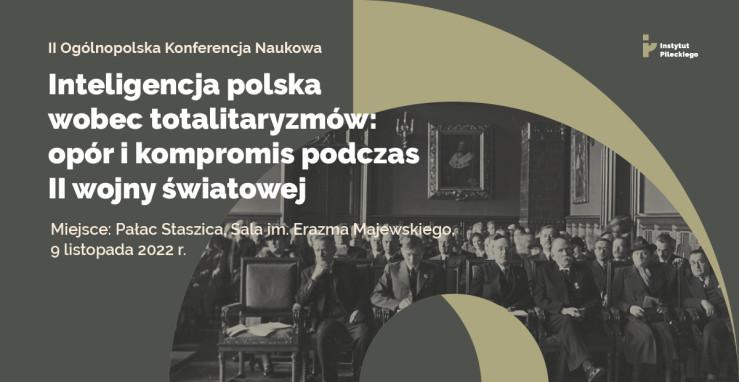
From the first days of the Second World War, the Polish intelligentsia was subjected to a brutal campaign of planned extermination perpetrated by the Germans and the Soviets, which, although decimated, it somehow survived. Its resistance manifested itself not only in military struggle, but also in civic opposition. This leads to a host of research-related questions. How did the Polish intelligentsia plan and implement resistance? What were the forms of opposition or compromise? What were their limits? What was the role and
spectrum of activities undertaken by the intelligentsia in Nazi German concentration camps and Soviet labor camps? What aspects were crucial for its leaders? We will try to answer these and many other questions of key importance for modern Polish history during the IInd International Scholarly Conference “The Stance of the Polish Intelligentsia Towards the Totalitarian Regimes: Resistance and Compromise”, organized by the Center for Totalitarian Studies at the Pilecki Institute as part of a research and publishing project initiated by the Institute.


See also
- Call for Papers | Exile Governments and Political Refugees in 20th-Century Europe: Sovereignty in the Face of Totalitarianisms (Deadline: November 15)
conference
Call for Papers | Exile Governments and Political Refugees in 20th-Century Europe: Sovereignty in the Face of Totalitarianisms (Deadline: November 15)
The year 2027 marks the 85th anniversary of the signing, on 13 January 1942, of the Declaration of St James’s Palace on the Punishment of War Crimes. To commemorate this landmark event, we are organising an international academic conference addressing the history and significance of governments in exile and political refugees in 20th-century Europe.
- Conference “Shared Experiences – Different Paths? The Turning Point of 1956 and Its Significance for the Countries and Societies of East Central Europe”
conference
Conference “Shared Experiences – Different Paths? The Turning Point of 1956 and Its Significance for the Countries and Societies of East Central Europe”
The Pilecki Institute and the Tadeusz Manteuffel Institute of History of the Polish Academy of Sciences invite you to participate in an international academic conference, Shared Experiences – Different Paths? The Turning Point of 1956 and Its Significance for the Countries and Societies of East Central Europe, which will be held on 19–21 October 2026 in Warsaw. The event is part of a series of conferences devoted to the history of transformations in East Central Europe after 1945.
- New Jork | The Augustów Roundup – the largest Soviet crime committed against Polish citizens after World War II. Workshops and Presentations
Event
New Jork | The Augustów Roundup – the largest Soviet crime committed against Polish citizens after World War II. Workshops and Presentations
Learn the history of the Augustów Roundup, a Soviet operation carried out in July 1945 that resulted in the arrest and disappearance of hundreds of people.