Debate "World War 2, Russia and Ukraine in the Era of the Smartphone War" - Instytut Pileckiego

debate
26.09.2025 (Fri) 18:30
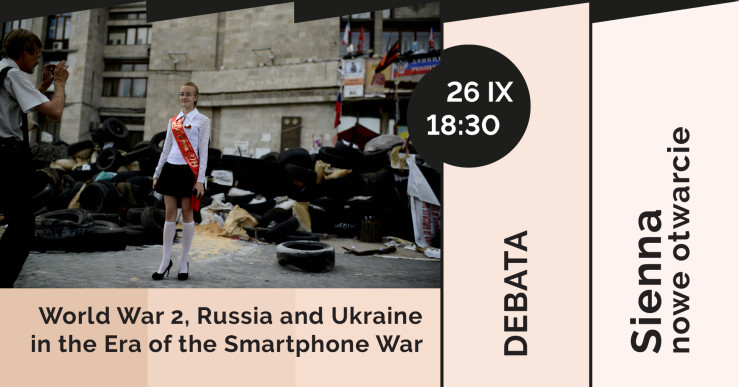
Debate "World War 2, Russia and Ukraine in the Era of the Smartphone War"
As part of the events accompanying the opening of the new headquarters of the Pilecki Institute at 82 Sienna Street, we invite you to a a debate on how Russia and Ukraine use and reinterpret the memory of World War II in the context of today’s war.
The history and memory of World War 2 has become an important battleground in Russia’s war against Ukraine. Simultaneously, the smartphone is bringing war – and the past – into daily life with ever more immediacy. In this panel, we show how both Russia and Ukraine are interpreting these memories.
Dr. Ian Garner will demonstrate how the Russian state uses social media and digital infrastructures to create a flexible – and falsified – memory of the war that, as it seeps into phones, feeds, and daily life, functions as propaganda to support the idea that Russia can “do it again” in a war against imagined fascism.
Meanwhile, Dr. Paweł Dobrosielski will discuss a major research project at the University of Warsaw that shows how ordinary Ukrainians are using historical comparisons to the suffering of World War 2 to make sense of their experiences. Together, we show how understanding historical use and abuses of the wartime past remains a vital task for academics and public commentators in the present.
The discussion will be moderated by Dr. John Cornell of the Pilecki Institute.
Presenters:
- Dr. Ian Garner (Pilecki Institute),
- Dr. Paweł Dobrosielski (Institute of Polish Culture, University of Warsaw).
- Dr. John Cornell (Pilecki Institute) - moderation
September 6 (Friday), 6:30 p.m.
Free admission (wstęp wolny)
Venue: Pilecki Institute, Sienna 82, IP auditorium (ground floor)
See also
- Call for Papers | Exile Governments and Political Refugees in 20th-Century Europe: Sovereignty in the Face of Totalitarianisms (Deadline: November 15)
conference
Call for Papers | Exile Governments and Political Refugees in 20th-Century Europe: Sovereignty in the Face of Totalitarianisms (Deadline: November 15)
The year 2027 marks the 85th anniversary of the signing, on 13 January 1942, of the Declaration of St James’s Palace on the Punishment of War Crimes. To commemorate this landmark event, we are organising an international academic conference addressing the history and significance of governments in exile and political refugees in 20th-century Europe.
- Conference “Shared Experiences – Different Paths? The Turning Point of 1956 and Its Significance for the Countries and Societies of East Central Europe”
conference
Conference “Shared Experiences – Different Paths? The Turning Point of 1956 and Its Significance for the Countries and Societies of East Central Europe”
The Pilecki Institute and the Tadeusz Manteuffel Institute of History of the Polish Academy of Sciences invite you to participate in an international academic conference, Shared Experiences – Different Paths? The Turning Point of 1956 and Its Significance for the Countries and Societies of East Central Europe, which will be held on 19–21 October 2026 in Warsaw. The event is part of a series of conferences devoted to the history of transformations in East Central Europe after 1945.
- New Jork | The Augustów Roundup – the largest Soviet crime committed against Polish citizens after World War II. Workshops and Presentations
Event
New Jork | The Augustów Roundup – the largest Soviet crime committed against Polish citizens after World War II. Workshops and Presentations
Learn the history of the Augustów Roundup, a Soviet operation carried out in July 1945 that resulted in the arrest and disappearance of hundreds of people.