The letter from Roni Reiner, daughter of the survivor rescued by Józef Pruchniewicz’s family - Instytut Pileckiego

23.03.2021 (Tue)
The letter from Roni Reiner, daughter of the survivor rescued by Józef Pruchniewicz’s family
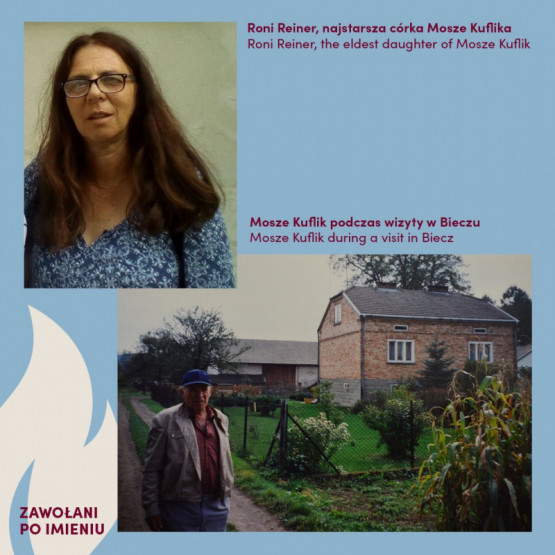
Moshe Kuflik was one of the Jews who survived the German occupation thanks to the aid provided by the Pruchniewicz family. Roni Reiner, the daughter of the survivor wrote a letter to the participants of the commemorative event honoring the murdered Pole.
As long as I remember myself, the holocaust was part of my life.
The loss of families, of entire communities, of a nation – was and still is unimaginable.
The evil, hate, the abuse of innocent, the chaos and the massive extermination were not just stories for me - but were part of my life as a daughter of holocaust survivors.
My Father, RIP, Moshe Kuflik, talked about the holocaust, shared stories that were scarred in his soul until the day he pass away.
He wanted us to know, wanted us not to forget the family that became ember. He asked us to never forget that small village in Poland, Dukla, where he was born and deported from, without any choice only because he was a Jew. Run away and hide day by day, orphaned, destitute, and lonely.
With the hard stories of the horrors, the unbelievable descriptions, was in his memories also a ray of light.
The light of one family that thanks to them, he was able to survive and go through the hellish years of war.
One family that risked their lives, home, resources, their entire world, to help Jews in such dark times.
The father of the family name was Jozef Pruchniewicz , his wife name - Maria. My dad also used to tell with excitement about their daughter – Jadwiga. My father was referred to her as an “Angel”.
The Pruchniewicz family didn’t just open their home to hide five haunted and beaten up human beings, they opened their soul for them. In an inhuman world, the Pruchniewicz family hided them near their house although the big danger and uncertainty.
Until the day it was discovered. From that day everything was not the same any longer.
Because of the discovery, Jozef was executed by the abominable Nazis.
The family was left with no father, without roots – the kids were orphans, Maria was a widow.
The Pruchniewicz family paid the highest price for an outstanding act of human kindness, of a divine spirit, of the love of human as human beings.
In the bible, there is a quote that is very relatable to the Pruchniewicz family: “In a place where there is no human - be one.”
The world cannot forget those special people forever, that in dark moments opened their souls and risk their entire world for other strangers, human beings – for love of the other, for getting rid of the darkness and bringing the light.
We will never forget the Pruchniewicz family and the glorious, noble act they did in those terrible, terrifying times. Times of destruction, deep hate and desecration of human dignity.
Roni Reiner
See also
- Previously unpublished German archival materials from France’s ECPAD at the Pilecki Institute and the Warsaw Rising Museum
News
Previously unpublished German archival materials from France’s ECPAD at the Pilecki Institute and the Warsaw Rising Museum
The Witold Pilecki Institute of Solidarity and Valor and the Warsaw Rising Museum have signed a strategic trilateral cooperation agreement with ECPAD (Établissement de Communication et de Production Audiovisuelle de la Défense / Defense Communication and Audiovisual Production Center), the French military audiovisual archive based in Ivry-sur-Seine, France. The agreement gives the Polish institutions access to unique Second World War photographs previously unseen in Poland, opens access to the vast holdings of the French archive, and launches a partnership of major significance for research into Polish history.
- „Soviet Central Asia as a Totalitarian Testing Ground” - international academic conference
News
„Soviet Central Asia as a Totalitarian Testing Ground” - international academic conference
Three days, dozens of presentations, and researchers from Poland and abroad summed up the international academic conference held at the Pilecki Institute in Warsaw on 2–4 September.
- The hitherto unknown memoirs of a German official from occupied Poland have been donated to the Pilecki Institute
News
The hitherto unknown memoirs of a German official from occupied Poland have been donated to the Pilecki Institute
A unique document has been added to the Pilecki Institute’s archives: the previously unpublished and unknown memoirs of a German official who worked in the civil administration of the General Government during the Second World War.
- Evil Woven into Everyday Life | Dr Joanna Nikel on the Memoirs of a German Official from His Stay in the General Government
News
Evil Woven into Everyday Life | Dr Joanna Nikel on the Memoirs of a German Official from His Stay in the General Government
"It is rare for a document to find its way into archival collections in which the voice of an official of the occupation apparatus himself – written down without any intention of accusation, and even stressing his own sense of normality – becomes one of the most eloquent testimonies to the criminal nature of the system he served", writes Dr Joanna Nikel in her initial commentary on the materials received by the Pilecki Institute.
- 14 books nominated for this year’s Witold Pilecki International Book Award
News
14 books nominated for this year’s Witold Pilecki International Book Award
On Saturday, 5 September, at the Autumn Book Fair in Warsaw, the Pilecki Institute announced the titles and authors of 14 books nominated for this year’s Witold Pilecki International Book Award.
- New Jork | Exhibition: Between Life and Death. Stories of Rescue during the Holocaust
News
New Jork | Exhibition: Between Life and Death. Stories of Rescue during the Holocaust
Through October 29, the Pilecki Institute in New York is hosting an exhibition about the people who risked their own lives to save Jews during the Holocaust—and those who survived thanks to their courage.
- „Soviet Central Asia as a Totalitarian Testing Ground” - international academic conference
News
„Soviet Central Asia as a Totalitarian Testing Ground” - international academic conference
The international academic conference organized by the Pilecki Institute is the first initiative in Poland to bring together interdisciplinary research on Soviet Central Asia, a region with an exceptionally complex history of totalitarianism, mass repression, and forced deportations, that also include the experiences of Poles.
- Karol Madaj appointed Director of the Witold Pilecki Institute of Solidarity and Valor
News
Karol Madaj appointed Director of the Witold Pilecki Institute of Solidarity and Valor
Marta Cienkowska, the Minister of Culture and National Heritage, has appointed Karol Madaj Director of the Witold Pilecki Institute of Solidarity and Valor in Warsaw. His five-year term will begin on 30 August 2026. From 1 September 2025, Karol Madaj served as the acting director of the Pilecki Institute.
- Hacker attack on the websites of the Pilecki Institute in Warsaw, Berlin, and Augustów
News
Hacker attack on the websites of the Pilecki Institute in Warsaw, Berlin, and Augustów
On the night of August 13–14 our websites suffered another serious hacking attack. Content bearing the hallmarks of Russian propaganda and disinformation — targeting Polish history and reinforcing anti-Ukrainian narratives — was deliberately placed on the Institute's pages devoted to Augustów, Berlin, and Warsaw.
- Academic conference “Oppositional Engagement of Women in Authoritarian and Totalitarian Systems of the 20th Century: Poland in a Comparative European Perspective (1919–1989)”
News
Academic conference “Oppositional Engagement of Women in Authoritarian and Totalitarian Systems of the 20th Century: Poland in a Comparative European Perspective (1919–1989)”
The second academic conference in a series “Oppositional Engagement of Women in Authoritarian and Totalitarian Systems of the 20th Century: Poland in a Comparative European Perspective (1919–1989)” brought together representatives of various fields of the humanities and social sciences from numerous research centers in Poland and abroad.
- Accountability for War Crimes. New book from Pilecki's expert
News
Accountability for War Crimes. New book from Pilecki's expert
It is an expanded English-language edition of the monograph "Problem odpowiedzialności karnej za zbrodnie wojenne w pracach rządu polskiego na emigracji (1939–1945)", which in 2023 was awarded a grant under the Ministry of Science and Higher Education’s “Excellent Science II” program for the translation and open-access publication of the book abroad.
- 12 July | Day of Remembrance for the Victims of the Augustów Roundup
News
12 July | Day of Remembrance for the Victims of the Augustów Roundup
12 July is celebrated as the National Day of Remembrance for the Victims of the Augustów Roundup. The roundup began 81 years ago on this day – on 12 July 1945, two months after the end of the Second World War.