Aleksandra and Hieronim Skłodowski commemorated for assisting Jews - Instytut Pileckiego

project
16.06.2019 (Sun) 16:30
Aleksandra and Hieronim Skłodowski commemorated for assisting Jews
On Sunday, 16 June 2019, two people were commemorated in Skłody-Piotrowice within the framework of the project “Called by Name.” Aleksandra and Hieronim Skłodowski had been murdered by German gendarmes for helping Jews.
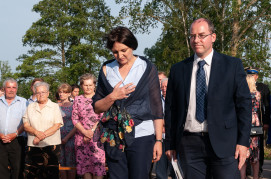
A memorial was unveiled near the house at no. 6, where the commemorated were murdered. Before the ceremony, a mass was held at the Saints Simon and Jude Thaddaeus Church, with the family of the murdered, local authorities and representatives of local associations and organizations in attendance in addition to members of the local community, who turned out in great numbers. Speakers during the unveiling included Prof. Magdalena Gawin, Deputy Minister of Culture and National Heritage; Urszula Wołosiewicz, head of Zaręby Kościelne municipality; Zbigniew Chrupek, head of Ostrów Mazowiecka county; and Dr. Wojciech Kozłowski, Director of the Pilecki Institute.

“The history that we are commemorating did not happen in Warsaw, Łódź or Gdańsk. It happened here. These are your heroes,” said Prof. Magdalena Gawin to those gathered at the ceremony. “The national and local media will talk about them, but my wish is for the documentation of those events to stay here, to always be available at the [local] school or library so that the residents, especially young people, can always have it at their fingertips.”
A letter from Prime Minister Mateusz Morawiecki to the organizers and participants of the ceremony was also read out: “Today we especially highlight the significance of quiet deeds, local heroes whose heroic stance remains unknown to society at large. It is them that – as the name of the project states – we wish to ‘call by name’.”
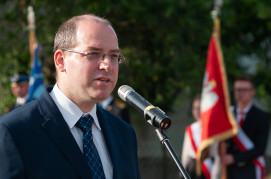
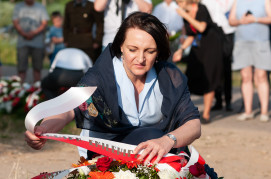
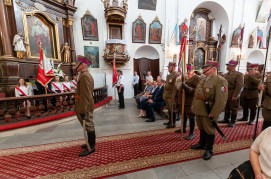
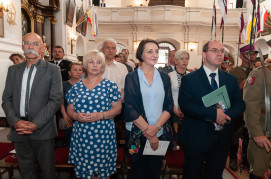
During the German occupation the Skłodowski family of Skłody-Piotrowice sheltered unknown Jews. The Germans found out about it. On 20 January 1944, gendarmes from the posts in Andrzejewo, Jasienica and Zaręby Kościelne surrounded the farm buildings. Those at home at the time (aside from Hieronim Skłodowski) included his mother Aleksandra, his sister Apolonia, and his wife Amelia along with their five children: Leonard, Irena, Natalia, Cecylia and Włodzimierz.

The details of the murder have come down through eyewitness accounts, including the account of Leonard, who was 13 at the time. Having barred the escape routes, the German gendarmes made everyone come out and stand against a wall. Only bedridden 82-year-old Aleksandra Skłodowska remained inside. Even when beaten, Hieronim Skłodowski did not confess that he was hiding Jews. At the behest of the gendarmes, the barn was searched, revealing a hiding place concealed with hay (empty at the time of the search). Once evidence of the “crime” was found, Hieronim Skłodowski was taken behind the barn and, after several minutes, shot. The family was ordered to get onto carts that had been brought in, and they were transported to the remand prison in Jasienica. After the family were gone, one of the gendarmes killed Aleksandra Skłodowska in her bed. The bodies of the mother and son were buried near the farm buildings. Once released, the Skłodowskis were prohibited from returning to their home, which had been seized, and lived in nearby Skłody Średnie until the end of the occupation.
“Let us remember in our prayers those who took the biblical commandment ‘There is no longer Jew or Greek’, that all men are brothers, to heart so much that they gave their lives for it,” said Rev. Andrzej Dmochowski, parish priest of Zaręby Kościelne, who celebrated the mass.
See also
- Call for Papers | Exile Governments and Political Refugees in 20th-Century Europe: Sovereignty in the Face of Totalitarianisms (Deadline: November 15)
conference
Call for Papers | Exile Governments and Political Refugees in 20th-Century Europe: Sovereignty in the Face of Totalitarianisms (Deadline: November 15)
The year 2027 marks the 85th anniversary of the signing, on 13 January 1942, of the Declaration of St James’s Palace on the Punishment of War Crimes. To commemorate this landmark event, we are organising an international academic conference addressing the history and significance of governments in exile and political refugees in 20th-century Europe.
- Conference “Shared Experiences – Different Paths? The Turning Point of 1956 and Its Significance for the Countries and Societies of East Central Europe”
conference
Conference “Shared Experiences – Different Paths? The Turning Point of 1956 and Its Significance for the Countries and Societies of East Central Europe”
The Pilecki Institute and the Tadeusz Manteuffel Institute of History of the Polish Academy of Sciences invite you to participate in an international academic conference, Shared Experiences – Different Paths? The Turning Point of 1956 and Its Significance for the Countries and Societies of East Central Europe, which will be held on 19–21 October 2026 in Warsaw. The event is part of a series of conferences devoted to the history of transformations in East Central Europe after 1945.
- New Jork | The Augustów Roundup – the largest Soviet crime committed against Polish citizens after World War II. Workshops and Presentations
Event
New Jork | The Augustów Roundup – the largest Soviet crime committed against Polish citizens after World War II. Workshops and Presentations
Learn the history of the Augustów Roundup, a Soviet operation carried out in July 1945 that resulted in the arrest and disappearance of hundreds of people.